How to Organize a Tool Chest
Here's how to organize a tool chest: group tools by task, keep daily tools within easy reach, and store heavy tools low. Measure drawers before adding liners, trays, dividers, or foam, then give every tool a fixed place.
On this page (10 sections)
- How to organize a tool chest step by step
- How should you group tools in a tool chest?
- Which tools belong in the top and bottom drawers?
- Do drawer liners help organize a tool chest?
- When should you use drawer dividers?
- When does foam make sense in a tool chest?
- What mistakes make a tool chest harder to use?
- How do you keep a tool chest organized?
- Which setup should you choose for your tool chest?
- Related guides
Here's how to organize a tool chest: group tools by task, keep daily tools within easy reach, and store heavy tools low. Give each tool a home you can see and reach without moving a pile.
Start with the tools you use, then add organizers to solve specific problems. A liner helps with sliding, trays separate small parts, dividers create zones, and foam gives equipment a shaped space.
How to organize a tool chest step by step
Empty, sort, measure, and arrange before buying organizers. Plan one drawer at a time so you can check the fit without scattering the entire collection around your workspace.
- Empty each drawer onto a clear surface, keeping sharp edges covered.
- Remove dust, metal chips, and loose hardware, then wipe the drawer clean and dry.
- Group tools by type or the jobs you use them for.
- Set aside broken tools, unused duplicates, and supplies stored elsewhere.
- Measure the usable width, depth, and height inside each drawer.
- Arrange tools loosely before fitting liners or organizers.
- Close each drawer gently to check clearance, then label the finished layout.
Measure inside the drawer, rather than using the chest's outside dimensions. Drawer lips, slides, and lock parts can reduce usable space.
Leave enough room to grip handles and lift tools out. A drawer packed edge to edge may hold more pieces, but it makes every return harder.
How should you group tools in a tool chest?
Group tools by type when you use them across many jobs, or by task when you regularly need the same kit. Keep the groups broad enough that putting tools away takes little thought.
A socket drawer might hold ratchets, extensions, and sockets arranged by drive size. Separate metric and inch sets so similar sizes don't get mixed together.
For home repairs, measuring and marking tools can share a zone. Electrical tools can sit together, while cutting tools need a place where exposed edges won't catch your fingers.
Keep frequent-use tools toward the front and occasional pieces farther back. Avoid hiding a daily screwdriver underneath a larger tool just because both fit the same drawer.
How should you organize a tool chest for small parts?
Use separate compartments for bits, fasteners, and small accessories. Label compartments by size or purpose instead of keeping one mixed tray of leftover hardware.
The A-LUGEI Tool Box Organizer includes 69 interlocking plastic trays in 5 sizes, ranging from 3 x 3 in to 12 x 6 in. It suits a chest with several drawers of small tools and parts that need flexible groupings.
The trays are 1.8 in tall, so check clearance with the contents inside. Arrange them empty first, joining the compartments you need without trying to use the whole set at once.
Choose this set for mixed accessories that change over time. Skip it if you mainly store bulky tools, already have fitted bins, or need closed containers for tiny parts during transport.
Which tools belong in the top and bottom drawers?
Keep daily hand tools near a comfortable working height and heavy equipment in lower drawers. Follow the chest maker's limits for each drawer and for the cabinet as a whole.
Use shallow drawers for tools that can lie in one layer. Reserve deeper drawers for bulkier equipment, allowing room above handles, cases, and attachments.
Spread weight across suitable lower drawers instead of concentrating everything in one. Open one drawer at a time, and use caster brakes while working if your chest has them.
Read how heavy a tool chest gets when loaded before moving a full cabinet. Tools, hardware, and organizers all add to the load.
If the layout still feels cramped after removing unused gear, compare tool chest sizes. More compartments won't solve a drawer that's too shallow for its contents.
Do drawer liners help organize a tool chest?
Use a liner where tools slide or strike the drawer surface. It adds grip and cushioning, but it doesn't create separate homes for loose sockets or fasteners.
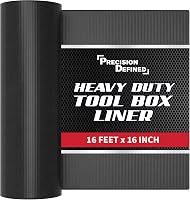
The Precision Defined Non-Slip Drawer Liner is a 16 ft x 16 in washable roll with straight grid lines to guide cuts. Choose it when several drawers need a cut-to-fit base rather than separate compartments.
Map your drawer measurements onto the roll before cutting. A drawer wider than the roll may need more than one piece, so plan seams away from areas where small tools could catch.
Cut on a separate surface with a straightedge, keeping fingers clear of the blade. Fit the liner flat without bunching it against the drawer sides.
Skip an extra layer beneath fitted organizers if it leaves too little clearance. Our guide to tool chest drawer liners explains how to choose and fit a drawer base.
For care, remove tools and wipe this liner with a damp cloth. Let it dry before returning it and the tools to the drawer.
When should you use drawer dividers?
Choose dividers for broad zones in a drawer that has enough height and a suitable inside span. They suit groups of larger items better than loose screws or tiny bits.
The Vtopmart Tall Drawer Dividers are 6 in tall and expand from 12.8 to 22.3 in. These dimensions make them an option for deep drawers, rather than the shallow drawers common near a chest's top.
The 8-pack uses spring tension and silicone strips at the ends. Vtopmart says the strips help hold the dividers in place and protect drawer surfaces from scratches.
Clean the contact areas, adjust the length, and check that each divider sits securely. Confirm the drawer closes freely before adding tools, and don't use the partitions to brace a crowded pile of heavy equipment.
Choose these for separating bulky supplies in a compatible deep drawer. Skip them for shallow drawers or fine sorting, and see tool chest drawer dividers for other layout ideas.
When does foam make sense in a tool chest?
Choose foam for a stable set of tools or equipment that needs individual spaces. Defined cutouts make an empty spot easy to notice, but they take more planning than movable trays.
The DeWalt Tool Organizer Foam Insert uses removable blocks and measures 16.77 x 11.7 x 2.73 in. It's part of the TSTAK system and fits DWST17808, DWST17807, and DWST17805.
Choose it for those compatible boxes or another space whose dimensions you've checked carefully. TSTAK compatibility doesn't mean it will fit any tool chest drawer.
Place the equipment on the foam before removing blocks. Leave material between tool spaces and room to reach around handles, then remove small sections until the fit works.
Skip foam if you often swap tools or need the densest possible layout. Read foam tool organizers for tool chest drawers before committing to fixed spaces.
What mistakes make a tool chest harder to use?
Overfilling drawers and choosing organizers before measuring cause avoidable rework. Plan around access and clearance instead of trying to fill every gap.
Don't stack unrelated tools simply to clear the workbench. Use a deeper drawer for bulky gear, and move rarely used supplies elsewhere if they crowd daily tools.
Avoid mixing sharp cutting tools with items you grab without looking. Cover edges and keep blades in a separate, clearly marked area.
Don't force a drawer closed when something catches. Remove the obstruction and check the organizer height rather than pressing the contents down.
How do you keep a tool chest organized?
Return tools after each job and correct small problems as they appear. If one tool keeps ending up elsewhere, change its assigned place to match your routine.
Wipe dirt and moisture from tools before storage. Remove loose chips and debris from trays so they don't build up beneath small parts.
Keep labels short, such as “Metric sockets” or “Electrical.” Replace vague labels like “Miscellaneous” with the actual contents before the drawer becomes a catchall.
Leave some open space for new tools. When a drawer fills up, remove unused items before adding another layer.
Which setup should you choose for your tool chest?
Choose the organizer that solves your main problem: liner for sliding, trays for small parts, dividers for broad zones, or foam for fixed tool spaces. You can use different approaches in different drawers.
Start with one drawer and use it through a few jobs before arranging the rest. If finding and returning tools feels easy, repeat that approach where it fits.
Knowing how to organize a tool chest also means recognizing when the cabinet limits your layout. Use our rolling tool chests and tool boxes guide to plan the wider storage setup.
Related guides
Use these guides to check fit and plan your next drawer as you organize your tool chest.
- Tool chest drawer liners
- Foam tool organizers for drawers
- Tool chest drawer dividers
- Tool chest sizes
Frequently asked questions
How should tools be arranged in a tool chest?
Group tools by task or type, with daily tools within easy reach and heavier tools in lower drawers. Keep related pieces together, such as ratchets and extensions, and arrange tools so you can lift one out without moving several others or digging through a pile.
Should you put a liner in every tool chest drawer?
No, use a liner where tools slide or mark the drawer, and add trays when loose items need separate compartments. Leave a drawer unlined if the extra layer would interfere with a fitted organizer, and check that tools still clear the opening before filling the drawer.
How do you organize small parts in a tool chest?
Sort small parts into separate compartments by size, type, or use, and label similar pieces that are hard to tell apart. Keep metric and inch hardware separate, and use closed containers for very small parts that could spill when you move the chest or lift out a tray.
Where should heavy tools go in a tool chest?
Put heavier tools in lower drawers, following the chest's manual for drawer limits, total capacity, and weight distribution. Spread the load rather than crowding one drawer, and close drawers before moving the chest so tools and open drawers don't shift its balance while it rolls.