Tool Chest Drawer Dividers: Sizes and Setup
Choose tool chest drawer dividers by measuring the drawer's inside width, depth, and usable height. Use tension dividers for broad sections in deep drawers and modular trays for small parts or grouped tools.
On this page (10 sections)
- What size tool chest drawer dividers do you need?
- When should you choose tall adjustable dividers?
- Should you use organizer trays for mixed tools?
- Which organizer trays suit a hardware-heavy drawer?
- When does the larger A-LUGEI set make sense?
- How do you set up a tool chest drawer divider layout?
- Do liners help keep dividers in place?
- What mistakes make drawer organizers harder to use?
- How do you care for drawer dividers and trays?
- Which tool chest drawer dividers should you choose?
Choose tool chest drawer dividers by matching drawer clearance and tool shape first. Tension dividers create broad lanes in deep drawers, while shallow trays separate loose hardware and smaller tools.
Plan around what you need to find and return quickly. A drawer with a few useful sections works better than one packed with compartments that don't fit your tools.
What size tool chest drawer dividers do you need?
Use the drawer's clear interior measurements, including the space above its contents when closed. The chest's outside dimensions won't tell you which organizers fit.
Record these measurements with any liner in place:
- Width: the clear span between the inside walls.
- Depth: the usable distance from front to back.
- Height: clearance from the drawer floor to the lowest obstruction above it.
Account for curved corners, ribs, and hardware that interrupt the floor or walls. Our guide to tool chest sizes helps if you're also choosing a chest, but measure your actual drawers before ordering inserts.
Measure tool chest drawer dividers for both fit and access
A tension divider must fit the span between its contact points, and a tray must fit beside its neighbors. Leave finger room where you'll grip a tool or lift a container.
Measure the tools too, including wide handles and angled heads. A wrench that fits diagonally in an empty tray may become awkward to remove once nearby compartments are full.
Draw a simple layout on paper using the outside tray dimensions. Don't assume a tray's full footprint is usable space inside its walls.
When should you choose tall adjustable dividers?
Choose tall adjustable dividers for deep drawers that need a few broad sections. Skip them for shallow drawers or loose screws and washers that need separate containers.
The Vtopmart Tall Drawer Dividers, 8-Pack stand 6 in high, adjust from 12.8 to 22.3 in, and take up 0.8 in of width per divider. That height makes clearance the first buying check.
These clear plastic dividers use spring tension and silicone contact strips. Vtopmart says the strips help protect drawer surfaces from scratches; the brand also directs you to clean the drawer before installation.
They suit deep storage for bulky hand tools or separate task groups. Skip this set if you need low partitions beneath shallow drawer openings, or if the intended span falls outside its adjustment range.
A divider creates a boundary, not a fitted tool holder. Keep long tools lying flat rather than leaning them against the partition, and don't use extra spring pressure to compensate for a poor fit.
Should you use organizer trays for mixed tools?
Choose modular trays when tools and parts need separate, removable homes. They're useful when you want to carry a group of supplies to the bench and return it together.
The A-LUGEI Tool Box Divider Tray Set contains 46 plastic trays: 2 XL, 4 L, 8 M, 8 S, and 24 XS. They interlock or work separately.
Both A-LUGEI sets in this guide use the following tray footprints, all 1.8 in high:
| Tray size | Footprint |
|---|---|
| XL | 12 x 6 in |
| L | 9 x 6 in |
| M | 9 x 3 in |
| S | 6 x 3 in |
| XS | 3 x 3 in |
The 46-piece set suits a smaller sorting project with many little parts and fewer large tool groups. Skip it if your plan calls for many broad trays, since more than half the pieces are XS.
Start with the longest tools, then fit smaller containers around them. Leave oversized tools outside the trays rather than forcing handles over the edges.
Which organizer trays suit a hardware-heavy drawer?
Choose a set with plenty of small trays when separating fasteners, bits, and fittings is the main job. Count the distinct groups you need before counting available pieces.
The FLYVOLE Tool Box Organizer Tray Set, 60 Pieces includes 4 XL, 6 L, 12 M, 10 S, and 28 XS plastic trays. They interlock or can be used alone.
Its tray footprints range from 3 x 3 in to 12.5 x 6.2 in, with a stated tray height of 1.77 in. Plan with these measurements rather than treating it as interchangeable with the A-LUGEI sets.
FLYVOLE suits a mixed hardware collection with some longer tools alongside it. Skip this quantity if you only need a few sections, or if most of your tools need uninterrupted drawer space.
Separate similar-looking fasteners by size or thread type and label their compartments. Keep fill levels low enough to see the contents and pick out one part without spilling others.
When does the larger A-LUGEI set make sense?
Choose the larger set for a measured multi-drawer plan, especially when you need more medium and large compartments. A higher piece count helps only when the tray mix matches your tools.
The A-LUGEI Tool Box Organizer contains 69 plastic trays: 4 XL, 8 L, 12 M, 15 S, and 30 XS. Its trays interlock or work separately.
Compared with the smaller A-LUGEI set, it adds more trays in every size. Choose it when several drawers need sorting or your layout calls for more long and wide compartments.
Skip it for a single drawer with only a few tool groups. Map each drawer first so spare trays don't become another storage problem.
These are open containers, so they suit drawer storage rather than sealed transport of tiny parts. For a broader storage plan, see our guide to rolling tool chests and tool boxes.
How do you set up a tool chest drawer divider layout?
Arrange the tools first, then fit compartments around them. This keeps the organizer from dictating a layout that wastes space or buries useful items.
- Empty the drawer and remove grit, metal filings, and unused items.
- Group tools by task, then separate small hardware by type and size.
- Place the largest tools and trays first.
- Put frequent-use items near the front.
- Fit dividers or connect trays without forcing them against the walls.
- Close the drawer slowly and check clearance.
- Add labels where similar items could be confused.
Keep related items close, such as a driver and its bits, but avoid stacking tools just to make the plan fit. Leave a small open area for awkward shapes or temporary job supplies.
For the full drawer-by-drawer process, see how to organize a tool chest. If the floor needs protection before dividers go in, compare tool chest drawer liners.
Do liners help keep dividers in place?
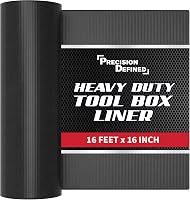
A flat liner can reduce tray movement, while tension dividers need secure contact with the drawer walls. Fix folds or curled edges before arranging either type.
A liner uses some vertical space, and tools sitting inside trays need clearance above the tray floor. Don't judge fit by organizer height alone.
Read our guide to tool chest drawer liners for fitting and material choices. For individual shaped tool positions, see foam tool organizers for chest drawers.
What mistakes make drawer organizers harder to use?
The main mistakes are overfilling compartments, ignoring clearance, and buying the wrong tray mix. Correct the layout before adding more organizers.
Don't assume every tool needs its own compartment. Broad groups work well for pliers or measuring tools, while similar-looking hardware benefits from finer separation.
Don't fill every gap just because a small tray fits there. A little space around lift-out containers makes cleaning and access easier.
Check drawers with their normal load, since shifting tools can expose problems an empty layout hides. Organizers don't increase a drawer's load capacity, so keep the chest manufacturer's limits in mind.
How do you care for drawer dividers and trays?
Keep contact points and tray bottoms free of grit, and clean up spills before returning tools. Debris under an organizer can scratch the drawer and make the layout uneven.
Lift out trays periodically, empty them, and wipe them with a damp cloth. Dry the trays and drawer before putting metal tools back, and follow the brand's care directions before using cleaners.
Check tension dividers for movement and worn contact strips. If a section shifts repeatedly, change its position or layout rather than wedging it tighter with loose scraps.
Which tool chest drawer dividers should you choose?
Choose tool chest drawer dividers by the groups you need to separate, then confirm that the organizer and loaded tools clear the drawer opening.
- Deep drawers with broad sections: choose Vtopmart if its height and adjustment range fit.
- A smaller sorting project: choose the 46-piece A-LUGEI set when its small-tray-heavy mix matches your parts.
- Hardware with mixed tool groups: choose FLYVOLE when its tray counts and footprints suit your layout.
- Several drawers to organize: choose the 69-piece A-LUGEI set when you need its extra medium and large trays.
If every tool needs a fixed position, compare foam tool organizers for chest drawers before filling the drawer with bins. For more storage ideas, browse the organizing and liners guide.
Frequently asked questions
How do I measure a tool chest drawer for dividers?
Measure the clear inside width, front-to-back depth, and usable height below the drawer above. Subtract space taken by liners, ribs, or other obstructions, then compare the remaining space with each divider or tray; tools must also clear the opening when the drawer closes.
Are drawer dividers or organizer trays better for tools?
Choose dividers for broad lanes of long tools and trays for loose hardware or smaller tool groups. Dividers leave tools on the drawer floor, while trays add separate containers you can lift out; use the shapes of your tools and your available clearance to decide.
Can tool chest drawer dividers scratch a drawer?
Dividers can scratch a drawer when grit gets trapped at contact points or an end slides against the finish. Clean the drawer before fitting them, keep protective pads free of debris, and use only enough tension to secure the divider according to its instructions.
Should I use foam or trays in a tool chest?
Choose foam for a stable collection of tools that each need a shaped space, and trays for groups of parts or tools that change often. Foam makes an empty tool position easy to spot, while trays let you rearrange whole groups without cutting a new layout.