Tool Chest Drawer Liners: What to Buy and How to Fit Them
Choose a tool chest drawer liner by its usable width, coverage, and fit beneath your tools. Measure every drawer floor, plan the cuts, and leave the liner flat with clear edges.
On this page (7 sections)
- What should you measure before buying a tool chest drawer liner?
- Which drawer liner suits your tools and project?
- How much liner should you buy?
- How do you cut and fit the liner?
- Which fitting mistakes cause trouble?
- How should you clean and maintain a drawer liner?
- Which tool chest drawer liner should you choose?
The right tool chest drawer liner fits the drawer floor and your tool layout without bunching or catching at the edges. Choose the roll width first, then work out how much length your cuts will use.
A liner adds cushioning and grip beneath tools, but it won't keep every socket, wrench, or screwdriver in its own place. Use it as the base for a layout that separates loose items.
If you're rearranging the contents too, start with how to organize a tool chest. Decide where tools belong before cutting around trays or holders you may later move.
What should you measure before buying a tool chest drawer liner?
Measure the inside width and depth of each flat drawer floor, plus the clearance beneath tall tools and fitted trays. Outside chest dimensions won't tell you the size of liner you need.
Record every drawer separately, even when several look alike. Note fixed bolts, raised edges, and other parts that could stop a piece from sitting flat.
Check both possible cut directions before choosing a roll. A drawer's shorter floor dimension can run across the roll, while its longer dimension uses the roll's length.
For a one-piece liner, one drawer dimension must fit within the usable roll width. Extra roll length can't solve a width problem when both drawer dimensions are too large.
If you're still choosing storage, our tool chest sizes guide explains how to compare chest dimensions with your garage space. Measure the actual drawer interiors before ordering liner.
Which drawer liner suits your tools and project?
Choose Precision Defined for its grid-guided cuts and textured cushioning, or CASOMAN for a solid EVA surface with a stated thickness. Within each brand, buy the roll that matches your cut plan.
Both brands offer slip-resistant liners, but grip isn't a substitute for tool holders. A round tool can still roll, and small parts still need separate compartments.
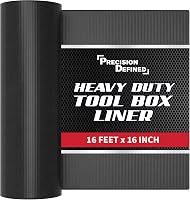
Precision Defined tool chest drawer liner for a mixed drawer project
The Precision Defined 16 ft roll suits buyers lining several drawers that fit its 16 in width. It uses polypropylene with a textured grip and what Precision Defined describes as a memory foam-like feel.
Choose this version if you want grid lines to guide repeated cuts across a mix of drawer sizes. Precision Defined says the material lies flat easily and provides cushioning beneath tools.
Skip it if your planned pieces need a wider roll or if you only want to line 1 small drawer. For a tight drawer with little space above the tools, confirm the thickness before choosing this option.
Precision Defined liner for broader drawers and larger projects
The Precision Defined 24 ft roll suits buyers who need more width or more total material. Its 18 in width can cover some drawer floors in one piece that the narrower rolls can't.
It shares the smaller version's polypropylene material, textured grip, grid lines, and memory foam-like cushioning. Choose it when those features suit your tools and your measurements justify the larger roll.
Skip it for a small repair unless you have a use for the remainder. If both dimensions of a drawer exceed the roll width, plan joined pieces or seek a wider liner elsewhere.
CASOMAN liner for a few drawers or a small repair
The CASOMAN 6 ft roll suits buyers refreshing a few selected drawers. Its EVA material is 2 mm thick, with non-slip surfaces on both sides and a solid washable top.
Choose it when you want a known thickness and don't need a long roll. The solid surface is also useful when you want to lift out loose grit rather than pick debris from an open mesh.
Skip it if your cut plan needs more than 72 in of roll length. It's sold as 16 in wide, while its dimensions give 15.94 in, so allow for that difference on a tight one-piece fit.
CASOMAN liner for several drawers with the same surface
The CASOMAN 16 ft roll suits buyers lining several drawers with matching EVA pieces. It provides the same 2 mm thickness and non-slip top and bottom surfaces as the shorter option.
Choose this version when you like the shorter roll's surface but need more material for your layout. Both CASOMAN versions can be cut with scissors or a razor.
Skip it when the drawer dimensions call for a wider sheet, or when you need shaped recesses for each tool. A flat liner adds a base layer; it doesn't create separate tool pockets.
How much liner should you buy?
Buy enough for your planned cuts, plus a small allowance for mistakes. Total floor area is a useful check, but it doesn't show whether the pieces fit across the roll.
For example, 4 drawers with floors measuring 24 by 15 in can each use a 24 in length from a roll wide enough for the 15 in side. Together, those cuts need 96 in, or 8 ft.
Draw the pieces on paper before cutting, starting with the largest. Save narrow offcuts for small drawers or compartments rather than assuming every scrap will be useful.
Don't count on stretching a piece to fill a gap. If no available roll covers a drawer in one piece, use flat sections with edges meeting cleanly, keeping the join away from loose small parts where possible.
You can also line only the drawers that need cushioning or grip. A drawer filled with fitted trays may gain little from another layer beneath them.
How do you cut and fit the liner?
Fit one drawer at a time, starting with a clean, dry floor. Use paper to trace awkward corners before cutting the liner itself.
- Remove the tools, trays, dust, and loose debris.
- Measure and mark the piece on a flat cutting surface.
- Cut slightly generously if you need room for final trimming.
- Place the piece in the drawer without stretching it.
- Trim small amounts until the edges lie flat.
- Check the drawer's movement before replacing the tools.
Precision Defined recommends a razor, while CASOMAN allows scissors or a razor. Use a straightedge and a cutting mat or scrap board when working with a blade.
Keep the blade away from the drawer's painted floor. A cut made inside the drawer can damage the finish even if the liner fits afterward.
If you're adding tool chest drawer dividers, check how their bases sit on the new surface. Refit them before loading small parts so you can spot any rocking or gaps.
Which fitting mistakes cause trouble?
The main mistakes are cutting too tightly, overlapping scraps, and ignoring clearance. Each can leave an uneven surface or stop a tray from sitting correctly.
Leave a small gap at the walls when a snug fit makes the liner buckle. Don't fold spare material up the sides or force the drawer shut to flatten it.
Avoid stacking layers for extra cushioning without checking tool height. Even a thin addition can matter beneath a tall socket rail in a shallow drawer.
Don't use liner to cover grit, damp patches, or a spill. Clean and dry the drawer first so debris doesn't remain trapped beneath the mat.
For a mobile chest, secure loose tools with holders or dividers before moving it. Our guide to tool chests on casters covers the broader setup concerns when storage moves around the garage.
How should you clean and maintain a drawer liner?
Remove loose debris and moisture promptly, and lift the liner periodically to clean beneath it. Metal shavings left under a mat can rub against the drawer finish.
Precision Defined specifies damp-cloth care; CASOMAN specifies a dry cloth for routine care. All 4 options are washable, but that doesn't establish resistance to solvents, fuel, or other workshop chemicals.
Don't assume a household degreaser is suitable for the material. Start with the stated care method, and confirm compatibility before using a stronger cleaner.
Let both surfaces dry before refitting the liner. Replace a piece that stays curled, tears, or no longer provides a flat base for your tools.
Which tool chest drawer liner should you choose?
Choose by drawer fit first, then surface and project size. Precision Defined suits buyers who value grid-guided cutting and textured cushioning; CASOMAN suits buyers who want solid EVA with a known thickness.
Pick the shorter roll when it covers your planned cuts with some spare material. Move to a longer or wider option when your measurements require it, rather than buying extra coverage without a plan.
If your goal is a separate place for every tool, compare foam tool organizers for chest drawers before buying a flat tool chest drawer liner. For help choosing the storage around that layout, see rolling tool chests and tool boxes.
Frequently asked questions
How do you measure a tool chest drawer for liner?
Measure the inside width and depth of the flat drawer floor, rather than the chest's outside dimensions. Record each drawer separately, including any raised edges or fixed hardware, then plan how its piece will fit across the roll and how much roll length the cut will use.
Should tool chest drawer liner cover the whole drawer?
Cover the flat floor where tools rest, leaving enough edge clearance for the liner to lie flat. Don't fold it up the walls or overlap pieces beneath tools; check that the drawer closes freely and that any trays still sit level before loading the drawer.
Can you wash tool chest drawer liners?
All 4 liners here are washable, but their routine care directions differ. Precision Defined specifies a damp cloth, while CASOMAN specifies a dry cloth; start with those methods, remove loose debris first, and let the liner and drawer dry fully before putting them back together.
Is foam or EVA better for a tool drawer liner?
Choose by fit, surface, and clearance rather than the material name alone. Precision Defined uses polypropylene with a memory foam-like feel, while CASOMAN uses 2 mm EVA with non-slip surfaces on both sides; neither replaces fitted holders when you need tools locked into separate positions.