6 Best Stackable Tool Boxes (October 2026)
The best stackable tool boxes include the Keter Stack-N-Roll 3-Piece Rolling Tool Box for home DIY projects, the Craftsman VERSASTACK XL 4-Piece Rolling Tower for VERSASTACK users, and the Keter Stack-N-Roll 4-Piece Rolling Tool Box for indoor hardware sorting.
On this page (11 sections)
- How we chose the best stackable tool boxes
- Stackable tool box comparison
- Best stackable tool boxes by use
- How do you choose the best stackable tool box?
- Which wheels and handles suit your route?
- Do you need drawers or top-opening boxes?
- What water and dust protection do you need?
- How should you set up a new stack?
- How do you care for latches, drawers and seals?
- Which buying and loading mistakes should you avoid?
- Which stackable tool box should you choose?
The Keter Stack-N-Roll 3-Piece Rolling Tool Box is the best stackable tool box for most home users because it separates tools and small parts in a complete rolling set. Choose a different layout if you need front-opening drawers, frequent vehicle loading or wheels for rough ground.
Start with the tools you carry on a normal job, then choose the boxes that hold them. Buying the tallest tower first can leave you lifting unused modules just to reach a screwdriver.
Our guide to choosing a modular rolling tool box system explains the wider system choice. If you're comparing storage footprints, the Milwaukee Packout dimensions guide shows why individual module sizes matter as much as overall stack height.
Our picks at a glance
-
1
 Best for home DIY projects
Keter Stack-N-Roll 3-Piece Rolling Tool Box
9.1/10 our score
See it on Amazon -
2
 Best for VERSASTACK users
Craftsman VERSASTACK XL 4-Piece Rolling Tower
8.6/10 our score
See it on Amazon -
3
 Best for indoor hardware sorting
Keter Stack-N-Roll 4-Piece Rolling Tool Box
8.2/10 our score
See it on Amazon
- 4
 Best for rough groundCheck it
- 5
 Check it
FLEX Stack Pack 3-Drawer Tool Box
Best for frequent tool access - 6
 Check it
ToughBuilt StackTech Rolling Tool Box
Best for pickup truck transport
How we chose the best stackable tool boxes
We compared storage access, included modules, transport features and protection to identify which buyers each option serves. A complete home set ranks differently from a single rolling base or a drawer module that needs separate wheels.
The scores reflect those features and their fit for this search. They favor a useful starting setup for home projects, while the recommendations explain when a lower-ranked specialist is the better choice.
Piece counts need particular care. Craftsman's fourth piece is an adaptor, while the FLEX box is one module containing three drawers.
We also separated carrying capacity from storage volume. A box can support a heavy load without having the interior shape needed for your longest tool.
Stackable tool box comparison
Compare what arrives in the set before comparing how much it holds. Keter and Craftsman provide several connected pieces, while Klein and ToughBuilt are rolling bases and FLEX is a drawer module.
| Product | Best for | Pieces | Capacity | Dimensions | Our score |
|---|---|---|---|---|---|
| Keter Stack-N-Roll 3-Piece Rolling Tool Box | home DIY projects | 3 | 165 lb | 16.18 x 20.66 x 27.32 in | 9.1 |
| Craftsman VERSASTACK XL 4-Piece Rolling Tower | VERSASTACK users | 4 | 22.11 x 17.98 x 33.3 in | 8.6 | |
| Keter Stack-N-Roll 4-Piece Rolling Tool Box | indoor hardware sorting | 4 | 20.67 x 15.75 x 22.44 in | 8.2 | |
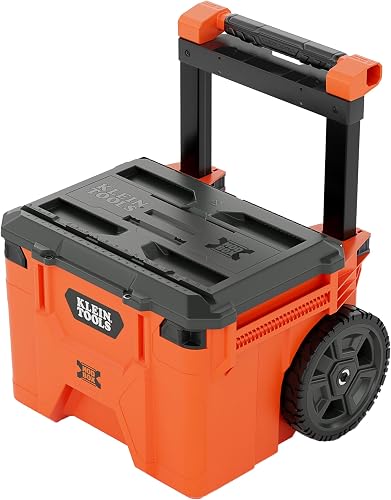
| Klein MODbox Rolling Tool Box | rough ground | 250 lb | 22.7 x 20.7 x 27 in | 7.6 | |
| FLEX Stack Pack 3-Drawer Tool Box | frequent tool access | 70 lb | 22 x 15.1 x 16.3 in | 7.0 | |
| ToughBuilt StackTech Rolling Tool Box | pickup truck transport | 56 L | 6.8 |
Use the table to narrow your choices, then check the access style. A deep top-opening box and a drawer module can occupy similar garage space while working very differently during a repair.
Best stackable tool boxes by use
Choose the storage layout that removes your main daily hassle, such as repeated unstacking, mixed hardware or awkward outdoor transport. These picks stay in score order, but each recommendation serves a different job.
Keter Stack-N-Roll 3-Piece Rolling Tool Box
- Cart, toolbox and parts organizer
- Telescopic metal handle
- 7 in wheels
- 165 lb capacity
A complete rolling set for home users who need separate spaces for tools and small parts. Choose it for mixed DIY jobs that do not call for drawer access.
Pros
- Three storage modules included
- Transparent small-parts organizer lid
- Audible snap-close latches
Cons
- No drawer module included
- Water resistance does not suit submerged storage
The Keter three-piece set suits homeowners who want to gather tools for a repair, roll them to the work area and put everything away together. Its cart, toolbox and parts organizer provide a sensible split between larger gear, hand tools and hardware.
The organizer's transparent polycarbonate lid lets you check small parts without opening it. Use that module for the fasteners and accessories you reach for often, rather than burying them beneath power tools.
A telescopic metal handle, side grips and 7 in wheels provide rolling and carrying options. Keter describes the resin construction as lightweight and intended for home use.
Choose this set if your work moves between a garage, driveway and indoor project area, and you can remove upper modules when needed. Its audible snap-close latches give a clear closure cue, though you should still check each connection before moving.
Skip it if drawers are essential to your routine. Repeatedly lifting an organizer to reach the box below is a poor fit when you need tools throughout a long assembly job.
Craftsman VERSASTACK XL 4-Piece Rolling Tower
- Three storage units and an adaptor
- Drop-and-lock connection with one-touch release
- 7 in wheels
- Water and dust resistance
Three storage units provide space for bulky tools, while the included adaptor connects other VERSASTACK boxes. A useful choice for buyers expanding within that system.
Pros
- Adaptor included for other VERSASTACK boxes
- Automatic stacking connection
- Suitcase and deep toolbox included
Cons
- Fourth piece is an adaptor, not another storage box
- Tower needs overhead clearance
The Craftsman tower makes the most sense for buyers who want several tool cases and a path to connect other VERSASTACK boxes. The included adaptor is the main reason to choose it over a stand-alone set.
You get a suitcase, deep toolbox and rolling unit, rather than four storage containers. That layout suits a kit divided by task, such as drilling equipment in one case and general repair tools in another.
Its drop-and-lock connection and one-touch release suit frequent changes between a full tower and a smaller working kit. Craftsman describes the body as water and dust resistant.
Skip it if you must lift the whole tower into a vehicle regularly. The empty set weighs 33.9 lb, so plan to separate modules before loading rather than treating the connected tower as one carry case.
Allow room above the stored stack to remove cases. For comparison with another connection style, our guide to separating and locking Milwaukee Packout boxes explains why release access deserves attention before buying.
Keter Stack-N-Roll 4-Piece Rolling Tool Box
- Rolling cart, two-drawer toolbox and two organizers
- Telescopic metal handle
- Transparent organizer lids
- 165 lb maximum weight recommendation
Drawers and two organizers suit dry garages with plenty of hardware and smaller tools to separate. Choose a different set for wet storage or exposed outdoor work.
Pros
- Drawers provide front access
- Two organizers with transparent lids
- Rolling base included
Cons
- Not water resistant
- Drawer layout needs clear space in front
The Keter four-piece set is the better home option when loose hardware and small tools create most of your clutter. A two-drawer toolbox and two organizers give those items more separate spaces than the three-piece version.
Assign one organizer to fasteners and the other to project accessories. Their transparent lids help you identify the correct tray before carrying it to a work area.
The drawers provide front access without opening a lid above them, provided you leave enough room for them to slide out. That makes this layout useful beside a garage work area where several tool types stay in rotation.
Keep this set in dry conditions. It is not water resistant, so it is a poor choice for exposed outdoor storage or jobs where rain protection is a priority.
Skip it if your kit is mostly bulky tools that need deep, open storage. If you also need a permanent work surface, our guide to tool chests with wood tops explains when a stationary chest can complement portable boxes.
Klein MODbox Rolling Tool Box
- 250 lb capacity
- 10 in solid rubber wheels
- Removable handle
- IP65 protection
A rolling base for buyers moving heavier tools over uneven routes. Larger wheels, a removable handle and IP65 protection make it a better fit for outdoor work than indoor parts sorting.
Pros
- Large solid rubber wheels
- Sealed against dust and water
- Removable telescoping handle
Cons
- Additional modules needed for a multi-box stack
- Empty weight adds to vehicle lifting effort
The Klein MODbox rolling box suits buyers whose route includes gravel, uneven ground or other obstacles that make small-wheel transport awkward. Its 10 in solid rubber wheels are the clearest reason to choose it over the home-focused sets.
The box supports up to 250 lb and uses sealed, impact-resistant polymers with IP65 protection. That combination fits outdoor tool transport better than a drawer-heavy setup intended to stay in a dry garage.
A removable telescoping handle helps when arranging the box in a vehicle. The lid also includes a V-groove and molded ruler for measuring and cutting tasks.
Choose Klein as the start of a MODbox stack when you need a substantial rolling base. You will need additional compatible modules to separate small parts from the main compartment.
Skip it for light indoor sorting if you do not need its wheels or protection. Its 30.4 lb empty weight still matters whenever you lift it, and our Milwaukee Packout alternatives guide can help compare other system layouts.
FLEX Stack Pack 3-Drawer Tool Box
- Three drawers with removable dividers
- Auto-locking drawers
- 70 lb load capacity
- Quick-connect latches
A drawer module for buyers who reach for small tools and hardware throughout a job. Included dividers help assign each item a place, but rolling equipment is separate.
Pros
- Removable dividers in each drawer
- Auto-locking drawer mechanisms
- Onboard security bar
Cons
- No rolling base included
- Drawer space needs checking for bulky tools
The FLEX drawer box suits buyers who reach for several small tools throughout a job and want each one accessible from the front. Its three drawers reduce the need to remove boxes stacked above it.
FLEX includes 6 long dividers and 18 short dividers, so you can separate sockets, bits, hardware and compact tools. Lay out the actual tools before fitting every divider; empty compartments are less useful than spaces sized around what you carry.
Auto-locking drawers help prevent opening during transport, while an onboard security bar adds a way to secure the drawers. Rust-resistant rails and quick-connect latches support regular drawer use and connection to compatible STACK PACK boxes.
Choose it for an existing STACK PACK setup or a planned stack centered on drawer access. Its 70 lb capacity applies to this module, rather than setting the limit for a whole connected tower.
Skip it if you need a complete rolling set immediately. It has no included rolling base, and large tools still need checking against the usable drawer space.
ToughBuilt StackTech Rolling Tool Box
- 250 lb maximum weight recommendation
- 9 in all-terrain wheels
- Removable telescopic handle
- Silicone lid gasket
A StackTech rolling base with a detachable handle for buyers fitting tools beneath a pickup cover. Measure the truck opening and cover clearance before choosing this setup.
Pros
- Removable handle for transport clearance
- Self-aligning stacking connection
- Accessory rails and two locking points
Cons
- Additional boxes needed for a multi-box stack
- Truck fit requires measurements
The ToughBuilt StackTech box suits buyers who want a rolling base with a detachable handle for vehicle loading. ToughBuilt designed the handle to help the box fit beneath many pickup tonneau covers, but measure your own clearance before relying on that fit.
Its self-aligning connection engages automatically when a compatible box drops into place and releases with one hand. That suits a routine where you build the tower for transport, then separate it at the work area.
The body combines polymer construction with powder-coated steel corners and a steel-reinforced lid. ToughBuilt says the silicone gasket seals out dust and water.
An inner tray separates smaller items, while accessory rails provide attachment points for compatible quick-release accessories. The 9 in wheels suit buyers planning a route over gravel or uneven floors.
Skip it if you need several storage modules included. This is one rolling box, so plan the rest of the StackTech setup before choosing it mainly for the removable handle.
How do you choose the best stackable tool box?
Choose by tool fit, access and transport route, in that order. A connection system only helps if its boxes hold your tools and let you reach them without unnecessary lifting.
Which stackable tool box layout fits your tools?
Choose deep boxes for bulky equipment, drawers for frequently used small tools and organizers for loose hardware. Spread your normal project kit on a bench before deciding how many of each module you need.
Measure the longest and widest tools with batteries, handles or cases attached. Exterior box dimensions include walls and other structure, so they do not establish usable interior space.
Also consider how tools come out. A tool that fits only when tilted may become awkward to remove once neighboring compartments are full.
Should you buy a complete set or build a stack?
Buy a complete set when its included modules match most of your kit. Build from individual modules when you already know you need a specific drawer, organizer or rolling base.
Count useful storage spaces rather than pieces. An adaptor adds connection options, but it does not replace a toolbox.
Check exact model compatibility before adding anything. Shared branding does not mean every connection or adaptor fits every box in that brand's range.
How much weight can you move comfortably?
Plan around the load you can control and lift, rather than filling a box to its maximum. The Keter sets have a 165 lb maximum weight recommendation, but that does not make a fully loaded stack suitable for every user or route.
Module limits and rolling-base limits serve different purposes. Adding another box does not increase the weight that the base, handle or connections can carry.
For vehicle loading, count the empty box weight as well as its contents. Our guide to how heavy a tool chest gets when loaded explains why storage weight can become a larger part of the job than expected.
Which wheels and handles suit your route?
Choose wheels around the worst regular surface between storage and the job. A smooth garage floor asks less of a rolling box than loose gravel, uneven paving or a raised doorway.
The home-focused Keter and Craftsman sets use 7 in wheels, while ToughBuilt and Klein offer larger wheels. Larger wheels generally approach small obstacles at a gentler angle, but load placement and wheel material also affect control.
A staircase changes the choice entirely. Plan to carry separate modules on stairs rather than relying on a wheeled tower to solve that part of the route.
Check the narrowest doorway and the space needed to turn while pulling the stack. A box that fits through a door straight on may still be awkward in a tight hall.
For vehicle use, measure the opening, interior height and handle clearance. A removable handle can help with fit, but it does not reduce the weight you must lift.
Do you need drawers or top-opening boxes?
Choose drawers for repeated access and top-opening boxes for bulky tools or task kits you remove together. The right choice depends on how often you need the lower part of the stack during a job.
Drawers earn their space when you reach for a socket, bit or hand tool every few minutes. They need clear space in front, which can be difficult beside a crowded bench or inside a packed vehicle.
A top-opening box works well when you take its contents out at the start and return them at the end. It becomes less convenient when upper modules must come off each time you need another item.
A mixed layout often works best. Keep bulky tools low, place frequent-use drawers where they remain accessible and carry small-parts organizers to the work surface when needed.
What water and dust protection do you need?
Match protection to each exact module, rather than assuming the whole system has one level of sealing. A protected rolling base cannot keep rain out of an unprotected organizer above it.
Klein has IP65 protection, Craftsman describes its tower as water and dust resistant, and ToughBuilt uses a silicone lid gasket. The Keter three-piece set is water resistant, while the four-piece set is not.
FLEX describes its drawer box as waterproof, but that term alone does not establish safe immersion conditions. Use covered storage and keep openings closed when exposed to weather.
Protection also depends on care. Dust, screws or a trapped strap along a lid edge can interfere with closure, so inspect the rim before fastening it.
How should you set up a new stack?
Load heavy items low and frequent-use items within easy reach, then check the arrangement before filling every compartment. Start with your normal project kit rather than every tool you own.
- Group tools by job. Keep drilling accessories near drilling tools and repair hardware near the hand tools used with it.
- Place dense items low. Avoid concentrating sockets, metal fittings or spare batteries in the highest module.
- Fit dividers around tools. Leave enough room to lift each item out without emptying its neighbors.
- Label removable modules. Clear labels help when boxes are separated or viewed from the side.
- Check every closure. Close lids and drawers, engage the stacking connections and confirm the handle position.
- Move the stack a short distance. Start on a clear, level surface and rearrange anything that shifts or makes the tower difficult to control.
Keep a little free space for the tools or supplies a project adds. Packing every compartment tightly makes it harder to return items during cleanup.
Our guide to organizing a tool chest offers more ways to group tools and assign storage spaces. The same approach works when those groups live in separate portable modules.
How do you care for latches, drawers and seals?
Keep connection points, drawer tracks and lid edges clean so the moving parts can close fully. Remove loose grit with a soft brush and wipe dirty surfaces before stacking the boxes again.
Dry wet tools before putting them away. A sealed box can keep outside moisture away while still trapping moisture brought in on its contents.
Inspect latches, handles and stacking connections after a hard knock. Stop using a damaged connection for transport until it is repaired or replaced.
Check the care instructions before adding lubricant to rails or latches. An unsuitable lubricant can attract dirt or affect nearby materials.
Close drawers before moving the stack and use the transport locks or security bar provided. A stacking connection, lid latch and theft lock serve different roles, so confirm each one separately.
Which buying and loading mistakes should you avoid?
Avoid choosing a stack by piece count, maximum capacity or tower height alone. Those numbers do not show how well the setup fits your tools, storage space or working routine.
- Buying too many modules at once. Start with the spaces you need now, then add a box when a clear storage gap appears.
- Ignoring lid and drawer clearance. Measure the space needed to use the box, not just park it.
- Assuming similar boxes connect. Verify the exact system and adaptor before combining modules.
- Burying daily tools at the bottom. Reserve lower top-opening compartments for items you remove once per job.
- Overloading one side. Spread dense tools across the available space so the stack is easier to control.
- Expecting a lock to secure the whole kit. A locked lid does not necessarily secure every module or attach the stack to a vehicle.
A tall stack can also be the wrong storage format for a narrow work area. Our complete guide to rolling tool chests and tool boxes helps compare modular boxes with drawer cabinets and other rolling storage.
Which stackable tool box should you choose?
Choose the best stackable tool box for your main task, then confirm that it fits your tools and transport route. Before ordering, decide where the heaviest tool will go and how you will reach the item you use most often.
- For mixed home repairs: choose the Keter three-piece set when you want a complete rolling setup without planning separate modules.
- For an expanding VERSASTACK kit: choose Craftsman when its included cases and adaptor match the boxes you want to connect.
- For dry garage sorting: choose the Keter four-piece set when drawers and separate hardware organizers solve your main storage problem.
- For frequent front access: choose FLEX when drawers matter most and you have planned compatible rolling equipment.
- For rough outdoor routes: choose Klein when larger wheels and sealed storage justify the extra lifting weight.
- For pickup loading: choose ToughBuilt when the removable handle and StackTech connection suit your measured vehicle space.
If two options still fit, choose the one that requires fewer lifts during a normal job. Use our modular rolling tool box system guide to plan the next module before committing to the wider system.
Our top 3 picks at a glance
-
1
Best for home DIY projects
Keter Stack-N-Roll 3-Piece Rolling Tool Box
9.1/10 our score
See it on Amazon -
2
Best for VERSASTACK users
Craftsman VERSASTACK XL 4-Piece Rolling Tower
8.6/10 our score
See it on Amazon -
3
Best for indoor hardware sorting
Keter Stack-N-Roll 4-Piece Rolling Tool Box
8.2/10 our score
See it on Amazon
Frequently asked questions
What makes a tool box stackable?
A stackable tool box has a connection that holds compatible modules together during storage or movement; depending on the system, that connection may use side latches, an automatic lock or an adaptor. Matching footprints alone do not prove compatibility, so confirm the exact connection before combining boxes.
Are stackable tool boxes good for a garage?
Yes, stackable boxes suit garages where tools need to move between storage and a project area; they keep separate tool groups together without spreading cases across the floor. Leave room to open lids or drawers, and choose only as many modules as your tools and daily work require.
Can I mix tool box brands in one stack?
Only use a mixed stack when a compatible connection or suitable adaptor supports those exact boxes; similar colors, widths or latch shapes are not enough. The included Craftsman adaptor connects other VERSASTACK system boxes; it does not establish compatibility with every modular brand or box size.
Should I choose drawers or a large toolbox?
Choose drawers for smaller tools and hardware you need repeatedly while other boxes remain stacked above; choose an open toolbox for bulky tools that need more uninterrupted space. Before ordering, measure your largest tool with its battery or case and compare it with the usable interior, not exterior dimensions.
What should I check before buying a rolling stack?
Check module compatibility, usable storage space, load limits, wheel design and handle clearance; measure the narrowest doorway, vehicle opening and storage spot along your route. Include empty box weight when planning lifts, and confirm protection for each module if the stack will face dust or wet conditions.