Plastic vs Metal Tool Boxes: Which Is Better? (October 2026)
For a plastic vs metal tool box, choose sealed rolling storage for travel or drawers for easy tool access. Pick the Milwaukee for mobile Packout storage, the Craftsman for a light tool kit, or the Tuffiom for a garage station.
On this page (12 sections)
- Plastic vs metal tool box: which should you choose?
- How do plastic and metal tool boxes differ?
- Which of these tool boxes fits your work?
- Is plastic or metal better for moving tools?
- Which type fits a home garage?
- Does metal protect tools better from impact?
- How should you set up a new tool box?
- How do you care for plastic and steel tool storage?
- What should you check before buying?
- Which buying mistakes should you avoid?
- Plastic vs metal tool box: which is better for you?
- Sources
For a plastic vs metal tool box, choose the layout and moving method first: a sealed rolling box suits travel, while drawers suit tools you want to reach quickly at a bench.
The Milwaukee, Craftsman and Tuffiom show why material alone is a poor shortcut. These are different storage formats, so the right choice depends on what you pack, where you work and how you get there.


Plastic vs metal tool box: which should you choose?
Choose the Milwaukee for a mobile tool kit, the Craftsman for a small set of portable drawers or the Tuffiom for a garage workstation. Start with your daily routine, then check whether the material and closures suit the conditions.
A deep box makes sense when you carry bulky gear together. Drawers make more sense when you reach for individual sockets, pliers or screwdrivers throughout a job.
These examples compare different formats as well as materials. They show useful buying tradeoffs, but they do not mean every plastic box rolls or every steel box has drawers.
Before shopping, sort your tools into 3 groups: items that travel, items that stay by the bench and small pieces that need their own compartments. You may need a portable kit and garage storage rather than one oversized box.
How do plastic and metal tool boxes differ?
The main differences are shell care, storage layout and carrying weight, but the exact model decides how those traits affect you. A box's size and hardware can outweigh any weight advantage from its material.
Is a plastic tool box lighter than a metal tool box?
Plastic does not always mean lighter. The Milwaukee weighs 23.4 lb empty, compared with 20.5 lb for the Craftsman and 40 lb for the Tuffiom.
Compare storage capacity and format alongside those figures. A larger rolling box and a compact carry chest serve different loads, so empty weight alone should not settle the choice.
Add the weight of your actual tools before planning a lift. Our guide to how heavy a loaded rolling tool chest can get helps you account for stairs, vehicle loading and tight turns.
Which material handles moisture better?
Plastic shells do not rust, but dry storage still matters for the tools and hardware. With steel storage, scratches that expose bare metal deserve attention before corrosion spreads.
Rain protection depends on the lid, joints and closures. A drawer chest without suitable weather protection belongs in a dry space even if its steel shell feels substantial.
Condensation can also form when cold tools move into warm, damp air. Let damp tools and storage dry before closing everything for the night.
Which offers better organization?
Drawers favor quick access; an open compartment favors flexible packing. Neither works well if you fill it so tightly that every task starts with unloading half the box.
Plan separate homes for tiny fasteners, sharp edges and heavy tools. Check usable interior space rather than assuming outside dimensions tell you what will fit.
If you already own connected cases, read about choosing a modular rolling tool box system. For shallow storage, tool chest drawer dividers can help separate small parts without burying them.
Which of these tool boxes fits your work?
The Milwaukee suits travel, the Craftsman suits a light bench kit, and the Tuffiom suits a garage station. Choose the one whose access and movement match your work, then check its limits.
Milwaukee: for tools that travel together
Choose the Milwaukee when your tools need to move between work areas and you want to build around Packout modular storage. Its impact-resistant polymer body pairs with an industrial-grade extension handle and 9-inch all-terrain wheels.
The box has an IP65-rated weather seal, plus metal-reinforced corners and a reinforced locking point. Those features make it the strongest match here for a travel routine that may include damp conditions.
Its single compartment needs a packing plan because the optional interior organizer tray is not included. Use suitable organizers for small pieces instead of letting them settle beneath larger tools.
Skip it if you mainly want shallow drawers beside a bench. Our Milwaukee Packout rolling tool box review explores that model in more detail.
Craftsman: for a small kit near the bench
Choose the Craftsman when you want 3 drawers in a carryable chest for a modest tool set. Its flip-up handle and sturdy latches suit moving between a dry storage spot and a nearby work area.
The key buying check is its 5 lb maximum weight recommendation. Confirm how Craftsman applies that limit before loading dense tools; do not assume a steel shell means it can carry a heavy mechanic's kit.
It is not water resistant, so plan indoor storage and a dry transport route. Skip it for regular outdoor work or if your kit exceeds its load guidance.
Its compact format is useful only if your tools fit the drawers. Measure your longest tools and check drawer space before choosing it over an open box.
Tuffiom: for a garage tool station
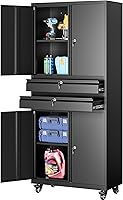
Choose the Tuffiom when you need 5 drawers and a bottom cabinet in one garage station. The removable, adjustable lower shelf helps divide that cabinet around larger items.
It has a handle and 4 wheels, including 2 with brakes. Locking bars keep the drawers and cabinet door closed during movement, while a side rack provides holes for small tools.
The top chest detaches and can fit inside the lower cabinet after you remove the inner shelf. Treat that as a storage and transport arrangement, rather than a reason to move a fully loaded assembly.
Skip it if your route regularly includes stairs, gravel or lifting into a vehicle. Its cabinet format makes more sense on a clear garage or workshop floor.
Is plastic or metal better for moving tools?
Choose the moving method before the material. A wheeled box helps on a suitable route, while a smaller carry chest may be easier when steps interrupt every trip.
Walk the full route from storage to the job. Check door sills, floor cracks, steep slopes and the space needed to turn without striking a car or wall.
Wheels do not remove the lift into a trunk or over stairs. If that lift would be awkward, split the kit into manageable loads instead of relying on the handle to solve the problem.
Keep the lid, drawers and doors secured before moving. With modular storage, check each connection and follow the system's instructions before rolling the stack.
A workshop cabinet also needs somewhere safe to park. Use brakes where supplied, and avoid working from a chest that can roll away as you pull a drawer.
Which type fits a home garage?
Choose drawers for a fixed work area and a rolling box for tools that leave it. Measure the space the storage needs while open, not just the footprint when closed.
The Milwaukee measures 22.1 x 18.9 x 25.6 in. Allow room above it to open the lid and reach the contents without dragging it out each time.
The Craftsman measures 20.6 x 9 x 13 in. A shelf or bench must support the loaded chest and leave enough clearance to pull its drawers fully.
The Tuffiom measures 11 x 23 x 40 in. Check access to its lower cabinet, and leave a clear standing area in front of the drawers.
Mark the footprint on the floor with removable tape, then park your vehicle and walk past it. Our tool chest size guide and guide to choosing a tool chest for your garage cover the broader space plan.
Does metal protect tools better from impact?
Metal is not an automatic winner for impact protection. Steel can dent, plastic can crack, and loose contents can damage each other inside either shell.
Construction matters at the corners, hinges, handle mounts and latch points. Choose around likely knocks during your routine rather than assuming a heavier box offers better protection in every case.
Pack sharp tools so their edges cannot strike the walls or nearby gear. Keep delicate measuring tools in suitable protective cases instead of dropping them among heavy sockets.
Do not use a tool box as a step or seat unless it is designed for that purpose. Load guidance for stored tools does not establish that a lid can support a person.
How should you set up a new tool box?
Build the layout around your most common jobs, with heavy items low and frequently used tools easy to reach. Leave enough space to remove an item without shifting several others.
Start with the tools you use every week. Store rarely used extras elsewhere until you know how much room your working kit needs.
For an open box, keep smaller pieces in containers that fit securely. Avoid stacking loose tools above fragile items or packing anything where it prevents the lid from closing freely.
For drawers, group tools by task or type and leave handles visible. Open only one loaded drawer at a time, especially on a narrow rolling chest.
Use suitable liners or dividers without blocking drawer travel or closure hardware. Our guide to organizing a tool chest helps turn those groups into a practical layout.
How do you care for plastic and steel tool storage?
Keep both types clean, dry and free of debris around moving parts. Regular checks of handles, latches, wheels and drawer movement catch problems before the next move.
Brush grit from lid edges and weather seals so the lid closes evenly. Use a mild cleaner suitable for the surface, and follow care instructions before applying solvents or oils.
Wipe moisture from steel surfaces and inspect chips or scratches in the finish. The Tuffiom has a powder-coated finish, but damaged areas still need attention rather than being ignored.
Do not seal wet rags or damp tools inside the box. Let the interior dry fully, and check underneath removable liners when moisture may have collected there.
If a latch will not close easily, rearrange the contents before forcing it. A tool caught across the opening can strain the closure and leave the lid uneven.
What should you check before buying?
Check tool fit, load guidance and access clearance before choosing a material. These checks prevent buying storage that fits the garage but fails your daily routine.
Measure bulky items such as drills, long handles and protective cases. For drawers, usable depth and height matter as much as the chest's outer width.
Read the load guidance for the exact model and any parts you plan to add. A box's total capacity does not establish the limit for an individual drawer, handle or attached module.
Check compatibility before adding modular storage to your cart. Similar colors or shapes do not mean cases from different systems will connect.
Finally, decide whether the tools must travel or simply stay organized nearby. Our comparison of tool chests and tool boxes explains the format choice before you commit to a larger setup.
Which buying mistakes should you avoid?
Avoid choosing by shell material while overlooking the loaded box. A dry, organized kit that you can move safely is more useful than extra storage you cannot reach or lift.
- Buying too much depth: Small tools disappear beneath bulky gear unless you provide separate storage.
- Confusing a lock with weather protection: A closed or locked box still needs suitable seals for wet conditions.
- Filling every gap: Leave room for fingers, tool removal and closures to work freely.
- Ignoring the return route: The box must fit back into the vehicle or garage after the job, with all tools packed.
- Planning around empty weight: Include organizers, accessories and tools in your carrying plan.
Plastic vs metal tool box: which is better for you?
Resolve your plastic vs metal tool box choice by matching the format to the job: mobile packing, light portable drawers or a garage workstation. Buy around the heaviest load and hardest part of your route.
Choose the Milwaukee if you want a rolling Packout base and can organize smaller items separately.
Choose the Craftsman if your kit fits its load guidance and you want compact drawers close to a dry workbench.
Choose the Tuffiom if the tools mostly stay in the garage and you need both drawer access and cabinet space.
If none matches your route and tool set, use our rolling tool chest guide to compare other storage formats before buying.
Sources
The product references below cover the models compared in this guide.
- Milwaukee Packout 22-Inch Rolling Tool Box: See it on Amazon
- Craftsman 3-Drawer Metal Portable Chest: See it on Amazon
- Tuffiom 5-Drawer Rolling Tool Chest: See it on Amazon
Frequently asked questions
Are plastic or metal tool boxes stronger?
Neither material is always stronger; construction, closures and load limits matter more than the label.
Choose a box that supports your tools without crowding them, and use fitted storage to reduce movement inside, since a hard shell cannot stop loose tools from striking each other.
Do plastic tool boxes rust?
Plastic shells do not rust, but steel tools and metal hardware can still corrode when moisture remains inside.
Dry tools before packing them, wipe away condensation and let a damp box dry fully before closing it, because a weather seal can also keep trapped moisture from escaping.
Is a metal tool box better for a garage?
A metal drawer chest is a good garage choice when you want tools spread out for quick access at a fixed work area.
Choose a portable chest for a small kit or a rolling cabinet for a larger station, then measure drawer clearance and the route around parked vehicles.
Which tool box is easier to carry?
The easiest box to carry is one you can lift comfortably with your actual tools inside, so compare loaded weight and handle position.
The Craftsman has a carrying handle, while the Milwaukee and Tuffiom offer wheels, but stairs and vehicle loading still require a separate plan for lifting.
Can a plastic tool box protect tools from rain?
A plastic tool box can protect tools from rain when its closure and weather protection suit that use; plastic alone is not enough.
The Milwaukee has an IP65-rated weather seal, but you should still close it fully, keep the seal clean and avoid leaving the box in standing water.