Keter Stack-N-Roll Tool Storage System Review: Worth It? (October 2026)
Keter Stack-N-Roll suits home DIY and garage storage when you need tools and hardware in one rolling stack. Choose the 3-piece set for a simple toolbox layout or the 4-piece set for drawers and separate small-parts organizers.
On this page (8 sections)
- Keter Stack-N-Roll review: which set should you choose?
- How do the handle, wheels and latches affect daily use?
- How much weight and storage space should you plan for?
- How should you set up the boxes before the first project?
- What care and storage habits matter most?
- Which common buying mistakes should you avoid?
- When should you choose Craftsman or FLEX instead?
- Is Keter Stack-N-Roll the right choice for your tools?
Keter Stack-N-Roll is a useful choice for home DIY tools that need to move together. The key decision is whether you want a simple toolbox or drawers that separate tools into smaller groups.
The 3-piece set suits a household repair kit, while the 4-piece set makes more sense for indoor projects with several types of hardware. Before choosing, plan what goes inside each section and how you'll move the loaded stack.
Keter Stack-N-Roll review: which set should you choose?
Choose the 3-piece set for simple storage and the 4-piece set for divided access. More pieces help only when they solve a storage problem you already have.
Keter Stack-N-Roll 3-piece: for a household repair kit
Keter Stack-N-Roll 3-Piece Rolling Tool Box

- Cart, toolbox and parts organizer
- Interlocking modular design
- Metal telescopic handle
- 7 in wheels
A straightforward rolling kit for household tools and repair supplies. Choose it when you need open toolbox storage more than drawers.
Pros
- Includes a cart, toolbox and parts organizer
- Transparent polycarbonate organizer lid shows small parts
- Side grips provide carrying points
- Water resistant
Cons
- Only one parts organizer is included
- No drawer toolbox in this set
This is the better starting point for a drill, hand tools and a modest collection of screws, anchors and bits. Put bulky items low in the cart, keep frequently used hand tools in the toolbox, and reserve the organizer for loose supplies.
The open toolbox layout gives you flexibility when your kit changes between jobs. A few larger items can share the space without needing to fit a drawer layout, though you'll still need to check their actual dimensions.
The organizer's transparent lid helps you spot the right supplies before opening it. Give each group a clear place so finding a wall anchor doesn't mean emptying a pile of mixed fasteners.
Skip this set if most of your work involves repeatedly reaching for small tools while other boxes remain stacked above them. A drawer layout better suits that routine, especially if you want separate spaces for measuring tools, pliers and bits.
The 4-piece set: for several indoor project kits
Keter Stack-N-Roll 4-Piece Rolling Tool Box

- Rolling cart, two-drawer toolbox and two organizers
- Interlocking modular design
- Metal telescopic handle
- 7 in wheels
A divided storage layout for indoor DIY work, with drawers for tools and separate organizers for different supplies.
Pros
- Two organizers separate hardware groups
- Two-drawer toolbox offers front access
- Transparent polycarbonate organizer lids
- Drawer lock bar
Cons
- Not water resistant
- Lock for the drawer lock bar is not included
Choose this configuration when you can name a purpose for each storage zone. For example, use one organizer for household fasteners and the other for electrical supplies, with frequently used tools divided between the drawers.
Front access is the main reason to choose the drawer toolbox. It can reduce the need to lift off upper boxes whenever you need another tool, provided you leave room in front of the stack.
Keep the drawer faces clear of stored boards, bags and other garage clutter. A drawer system parked tightly against another object loses much of its practical advantage.
Skip this version if your tools need a large open compartment more than separate drawers, or if you plan to work in wet conditions. Its lack of water resistance makes a dry garage, workshop or indoor project area the right setting.
How do the handle, wheels and latches affect daily use?
Both Keter sets provide a metal telescopic handle, 7 in wheels and side grips for moving the stack. Their snap-close latches make an audible click, but you should still check that each lid and connection is fully seated.
The wheels are useful for rolling between storage and a nearby work area. Steps, loose gravel, deep gaps and sharp thresholds still require planning, especially when the boxes contain dense tools.
Walk the route before loading the system. A narrow turn beside a parked car or a raised doorway can matter more than the distance between your garage and the project.
Use the side grips when carrying individual pieces, and keep your hands clear of connection points. For stairs or loading into a vehicle, separating the stack into manageable loads is often the more practical approach.
Don't pull hard against a stuck wheel or use the extended handle to force a loaded stack over an obstacle. Stop, reduce the load if needed, and choose a clearer route.
How much weight and storage space should you plan for?
Both Keter sets have a 165 lb maximum weight recommendation, but that is a limit, not a loading target. A load can become awkward to lift or control well before it reaches that figure.
Keep dense items low and distribute weight evenly from side to side. Avoid putting heavy tools in the top organizer just because there is space available.
The 4-piece system weighs 23.6 lb before tools. Include the containers themselves when deciding what you can lift into a trunk or carry over a step.
For help estimating a full kit, see how heavy a tool chest becomes when loaded. Count batteries, sockets and spare hardware as well as the larger tools you notice first.
For storage planning, measure your parking spot, door openings and vehicle cargo area. Leave working room above lids and in front of drawers, rather than measuring only the space occupied by closed boxes.
Compare your longest tool with the usable space inside its intended compartment. Exterior dimensions don't tell you whether a long level, saw or drill with a fitted battery will fit.
Our guide to tool chest sizes for a home garage explains the space checks that matter. If you're deciding between a modular stack and a cabinet, start with the rolling tool chest and tool box guide.
How should you set up the boxes before the first project?
Set up the system around how you reach for tools during a job. A useful layout keeps frequent items accessible and gives every loose supply a home.
- Sort your tools before loading. Separate bulky power tools, everyday hand tools, measuring tools and small hardware so you can see which group needs the most room.
- Load the lowest section first. Place dense items near the bottom, then check that nothing presses against a lid or connection when it closes.
- Keep task groups together. Store the bits, fasteners and small tools needed for one kind of repair near each other.
- Check each closure. Remove trapped straps, cords or loose hardware, close the lids, and confirm that the connections are engaged.
- Make a short first move. Roll the loaded stack along a clear route and adjust anything that shifts before taking it farther.
Label organizers by contents or task, such as “wall fixings” or “electrical.” Labels should still make sense when a box is removed from the stack and placed on a work surface.
Leave some room for returning tools after a job. If every compartment starts packed tightly, putting things away becomes slower and lids are more likely to meet an obstruction.
For a fuller layout plan, read how to organize a tool chest. The same grouping habits work in portable boxes.
What care and storage habits matter most?
Keep the boxes clean, dry and free of trapped debris at the lids, latches and connection points. Small chips and grit can interfere with closure even when the main storage area looks tidy.
Empty loose debris regularly and wipe surfaces with a damp cloth, then let them dry before closing. Avoid harsh solvents unless Keter's care instructions allow them.
Dry tools before storing them, and check for moisture after a damp project. A closed box can hold moisture around steel tools even when no rain enters during transport.
The 3-piece set is water resistant, but that does not make it suitable for standing water or permanent outdoor storage. Keep either configuration sheltered whenever possible.
Inspect wheels, grips and latches before moving a heavy load. If a part is loose or damaged, address it before relying on it to hold or move the stack.
The 4-piece set includes a drawer lock bar, with the lock sold separately. Use it as part of secure storage, while remembering that a portable box can still be carried away.
Which common buying mistakes should you avoid?
Avoid buying by piece count alone. The best arrangement is the one that fits your tools and makes them easy to retrieve.
A second organizer is useful when it keeps distinct supplies apart. It adds little value if both organizers will hold the same unsorted mix.
Don't assume that all boxes in a modular category connect to one another. Match the system and exact connection requirements before buying extra modules or accessories.
Also avoid treating load capacity as proof of jobsite durability. For material tradeoffs and storage conditions, read plastic vs metal tool boxes.
Finally, don't fill every drawer without considering access. Check that the tools fit below the closing edge and that the drawer can open fully where you plan to park the stack.
Our guide to tool chest drawer dividers explains how to separate small items without creating compartments too narrow for your tools.
When should you choose Craftsman or FLEX instead?
Choose Craftsman for outdoor DIY and VERSASTACK connections, or FLEX for drawer access in a workshop. These alternatives solve different needs, so neither is a direct replacement for every Keter buyer.
Craftsman VERSASTACK XL: for outdoor projects
Craftsman VERSASTACK XL 4-Piece Rolling Tower

- Suitcase, deep toolbox, rolling unit and adaptor
- Drop-and-lock stacking with one-touch release
- 7 in wheels
- Dust- and water-resistant design
A rolling tower for outdoor projects and buyers building around VERSASTACK boxes. The included adaptor provides a connection to other boxes in that system.
Pros
- Craftsman specifies dust and water resistance
- Automatic stacking and one-touch release
- Included adaptor for other VERSASTACK boxes
- Coated carry handle
Cons
- Additional VERSASTACK boxes are sold separately
- Heavier than the Keter 4-piece set
Craftsman's tower combines a suitcase, deep toolbox, rolling unit and adaptor. That mix suits buyers who need separate spaces for larger tools and want to connect other VERSASTACK boxes.
Craftsman specifies dust and water resistance, which makes this the stronger alternative here for outdoor DIY work. Its automatic stacking, drop-and-lock connection and one-touch release also deserve attention if you frequently separate modules.
The tower measures 22.11 x 17.98 x 33.3 in and weighs 33.9 lb. Check vehicle access and lifting needs before choosing it for regular transport.
Skip it if a simple household kit meets your needs and you have no use for the adaptor. Extra system options are useful only when you expect to use them.
Read the Craftsman VERSASTACK XL rolling tower review for a closer look at that layout.
FLEX Stack Pack: for frequent drawer access
FLEX Stack Pack 3-Drawer Tool Box
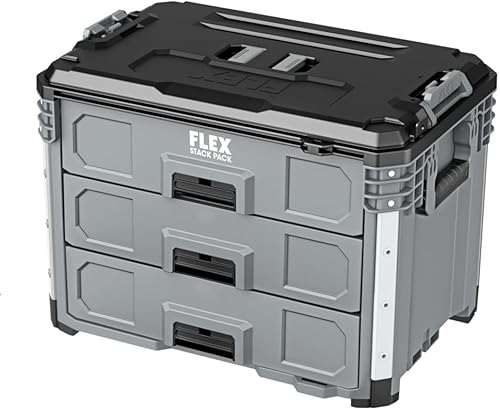
- Three drawers with removable dividers
- Auto-locking drawers
- Quick-connect latches
- 70 lb load capacity
A standalone drawer module for compact tools and hardware. Choose it for organized front access or to add to a STACK PACK setup.
Pros
- Auto-locking drawers help prevent opening during transport
- Removable dividers in each drawer
- Onboard security bar
- Aluminum-reinforced corners
Cons
- No rolling base is included
- One-year limited warranty requires registration within 30 days
FLEX suits a work area where compact tools and hardware need to stay within reach. Its 3 drawers include removable dividers, with 6 long and 18 short dividers supplied for arranging the contents.
The polypropylene body has aluminum-reinforced corners, and the drawer rails are rust resistant. Auto-locking drawers help keep them closed during transport, while an onboard security bar provides another way to secure access.
Its 70 lb load capacity applies to this drawer toolbox. It is not a complete rolling tower, so choose it only if standalone storage or a STACK PACK configuration fits your plan.
Skip FLEX if your main need is one ready-to-roll set for moving tools from the garage to household repairs. For other system choices, compare the best stackable tool boxes and Milwaukee Packout alternatives.
Is Keter Stack-N-Roll the right choice for your tools?
Choose Keter Stack-N-Roll 3-piece when an open toolbox and a small-parts organizer cover your household repairs. Choose Keter Stack-N-Roll 4-piece when divided tool access will save repeated unpacking and you can keep the system dry.
Choose Craftsman when outdoor work or existing VERSASTACK boxes drive the decision. Choose FLEX when your priority is organized drawers rather than a complete rolling set.
Before ordering, assign your tools to compartments and plan one full trip from storage to the work area. If either step exposes a mismatch, use our modular rolling tool box system guide to narrow the layout before choosing a brand.
Frequently asked questions
What comes with the Keter Stack-N-Roll 3-piece set?
The 3-piece Keter Stack-N-Roll includes a tool cart, toolbox and parts organizer with a transparent polycarbonate lid. The pieces interlock for storage and transport; this layout suits household tools and repair supplies when you want a main toolbox rather than a drawer unit.
What is the difference between the Keter Stack-N-Roll sets?
The main difference is the storage layout: the 3-piece set has a standard toolbox and one organizer, while the 4-piece set has a two-drawer toolbox and two organizers. Choose drawers for frequent tool access and separate organizers when you regularly carry different groups of hardware.
Is the Keter Stack-N-Roll water resistant?
The 3-piece set is water resistant, while the 4-piece set is not water resistant. Keep the 4-piece configuration indoors and move it under cover if rain starts; water resistance does not mean you should leave the 3-piece set outside or put wet tools away inside it.
How does Keter Stack-N-Roll compare with Craftsman VERSASTACK XL?
Keter offers a choice between a standard toolbox layout and a drawer layout for home storage. Craftsman VERSASTACK XL combines larger tool-storage units with an adaptor for other VERSASTACK boxes and a dust- and water-resistant design; choose around your tools, outdoor work and any system you already use.