Milwaukee Packout vs DeWalt ToughSystem: Which Is Better? (October 2026)
In Milwaukee Packout vs DeWalt ToughSystem, choose Packout for a shorter rolling-box footprint or ToughSystem for its included mobile-box tray and optional drawer access. Match your existing modules first, then choose the layout that keeps your daily tools within reach.
On this page (11 sections)
- Milwaukee Packout vs DeWalt ToughSystem: which fits your work?
- Who should buy each option, and who should skip it?
- Which box fits your vehicle, garage and route?
- How much weight can you carry?
- Which setup makes tools easier to reach?
- How should you set up the first stack?
- What matters on gravel, thresholds and steps?
- How should you care for seals, latches and drawers?
- Which buying mistakes should you avoid?
- Frequently asked questions
- Milwaukee Packout vs DeWalt ToughSystem: make the final choice
Choose Milwaukee Packout for a shorter rolling-box footprint, or DeWalt ToughSystem for an included mobile-box tray and optional drawer access. In Milwaukee Packout vs DeWalt ToughSystem, the useful difference is how each setup fits your space and lets you reach tools.
Start with the boxes you already have, then consider what you carry each day. A matching base can preserve useful storage, while a different access layout can reduce the number of boxes you move during a job.
 Best for tight storage spaces
Milwaukee Packout 22-Inch Rolling Tool Box
 Best for existing ToughSystem owners
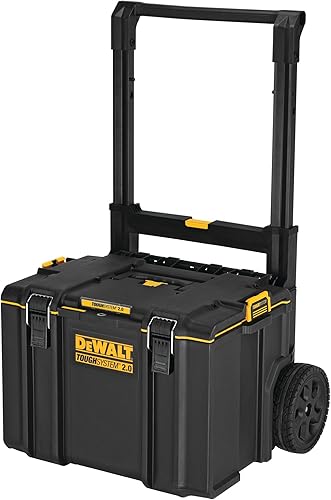
DeWalt ToughSystem 2.0 Mobile Storage
Milwaukee Packout vs DeWalt ToughSystem: which fits your work?
Packout suits a compact parking spot; ToughSystem suits buyers building around tray storage or front-access drawers. These specific products give you different layouts, so choose the box format before committing to the platform.
The Milwaukee rolling box has one main compartment. It suits a load of bulky tools that you usually unpack together, with separate organization needed for loose bits and small accessories.
DeWalt’s mobile box includes a removable inner tray. That helps when you want smaller tools above the main load, but reaching items underneath still means lifting the tray out.
The DeWalt drawer module solves a different problem: reaching tools while other modules remain above it. It belongs in this comparison as an access option, not as a substitute for either rolling base.
Milwaukee Packout vs DeWalt ToughSystem for existing owners
Keep your current platform if its storage layout already works. Packout connects with Packout modular storage products, and the DeWalt mobile box is backwards compatible with ToughSystem products.
Switching makes sense when you can name a recurring problem, such as poor access or a box that won't fit your vehicle. Brand preference alone won't fix either issue.
For a first system, plan a rolling base and the storage you need immediately. Our guide to choosing a modular rolling tool box system explains how to plan that first stack.
Who should buy each option, and who should skip it?
Buy around your daily tool load, not the largest stack you could build. Each option here suits a clear buyer, and each has a reason to pass.
Milwaukee Packout: for bulky tools and tighter parking
Choose the Packout rolling box if you need a main compartment for tools you carry together and have limited floor space. Its shorter stated footprint is useful when the box must park beside shelving or other equipment.
The industrial-grade extension handle and impact-resistant polymer construction suit a rolling storage role. The empty box weighs 23.4 lb, which matters if part of your route involves lifting rather than pulling.
Skip this specific box if your main goal is sorted access to many small hand tools. Its interior organizer tray is optional, so include that need in your setup plan.
DeWalt mobile storage: for a tray-equipped ToughSystem base
Choose DeWalt’s mobile box if you already use ToughSystem storage or want an included place for small tools above the main compartment. Its auto-connect side latches support one-handed operation when joining compatible modules.
The removable tray suits a group of tools you take out together, such as measuring and marking tools. It also lets you carry that group to a bench without emptying the main box.
Skip it if you cannot allow enough room for its stated dimensions. Also pass on a lid-access base as your main daily organizer if you'll constantly need tools buried beneath other modules.
DeWalt drawers: for tools you reach repeatedly
Choose the 3-drawer module for hand tools and accessories you use throughout a job. Its ball-bearing metal slides support drawer movement, while the front-access layout avoids removing the modules above.
Skip it for bulky tools that need deep storage. The unit's outside measurements don't establish usable drawer height or clearance around handles and fitted cases.
This is also a storage module, not a rolling base. Plan how you'll support and move it before treating it as a complete mobile setup.
Which box fits your vehicle, garage and route?
Measure the parking spot, transport space and narrowest turn before buying. A box that fits while standing still may still be awkward to load or turn.
The Packout rolling box measures 22.1 x 18.9 x 25.6 in. DeWalt’s mobile unit has stated dimensions of 38.81 x 19.89 x 23.79 in.
Use those outside measurements to plan clearance, not to calculate storage volume. Before ordering, confirm the exact dimensions and handle position for your vehicle opening.
Mark the footprint on your garage floor with tape. Then allow room to stand behind the box, operate the handle and open the lid without hitting shelving.
Vehicle access needs a separate check. Measure the opening as well as the space inside, and consider where your hands will go while lifting a loaded box through it.
For a wider storage plan, our rolling tool chest guide explains the difference between mobile chests and modular boxes. Use Milwaukee Packout dimensions and sizes when planning additional Packout modules.
Plan for drawer clearance too
Leave working space in front of a drawer stack. The DeWalt drawer module measures 21.3 x 12.4 x 12.7 in overall, but its closed footprint doesn't include space for opening drawers.
A stack parked tightly against a workbench may fit yet be inconvenient to use. Put it where you can stand comfortably and remove tools without blocking a doorway.
How much weight can you carry?
The rolling boxes have nearly equal maximum weight recommendations. Packout’s limit is 113 kg, about 249 lb, while DeWalt’s is 250 lb.
That near match makes load capacity a weak reason to choose one over the other. Tool shape, interior organization and the amount you can safely handle matter more.
A load limit is a ceiling, not a suggested everyday load. Add only the tools needed for the work, especially when the route includes steps or vehicle loading.
Keep dense items low and spread them across the base. Avoid placing a heavy tool high in the stack simply because an upper box has spare room.
Don't apply a rolling base's capacity to every attached module. Follow each component's own instructions, and check both individual module limits and the complete setup before adding weight.
Which setup makes tools easier to reach?
Use drawers for repeated access and a main compartment for tools you unload together. A tray sits between those approaches by grouping smaller items above a larger load.
Think through one typical job before choosing. If you reach for pliers, a tape measure and drivers throughout the day, give them a place that doesn't require dismantling the stack.
Bulky tools used once during setup can sit deeper. Storing them beneath a tray is less troublesome than burying the hand tool you need every few minutes.
Organize by task before buying more boxes
Group tools by the work they do together. A task kit can reduce searching without requiring a separate module for every tool type.
Lay out your tools in groups for measuring, fastening, cutting and cleanup. Keep loose accessories contained so they don't settle beneath larger tools during transport.
Leave some open space rather than packing every gap. You should be able to remove a tool without pulling out several unrelated items.
Our guide to organizing a tool chest offers grouping ideas you can also use in trays and modular boxes.
How should you set up the first stack?
Start with a low stack and add modules only after finding a clear storage need. This makes access problems easier to spot before the setup becomes heavy and awkward.
- Sort the load. Separate bulky tools, daily hand tools, small parts and items you rarely use.
- Place heavy items low. Keep the base balanced rather than loading one side with dense tools.
- Reserve easy access. Put frequently used tools in a reachable tray, drawer or upper module.
- Check every connection. Make sure compatible modules are fully seated and their connections are engaged.
- Check the route. Move the setup along your normal path with a light load before adding the full tool set.
Open lids and drawers where you expect to work. A stack that rolls neatly into a corner may need repositioning every time you want a tool.
For Packout connection steps, see how to separate and lock Milwaukee Packout boxes. Learn the release points before loading the stack so you can separate modules without forcing them.
What matters on gravel, thresholds and steps?
Both rolling boxes have all-terrain wheels, but route planning matters more than the label. Packout has 9 in wheels, while DeWalt’s mobile box has 8 in wheels.
Wheel diameter alone doesn't establish which loaded box will pull more easily. Surface depth, load balance, turns and stack height all affect movement.
Clear loose obstacles before pulling a stack across a threshold. Approach changes in surface slowly, and avoid dragging the setup sideways when a wheel catches.
Steps need a lifting plan. Don't assume a high load limit means you can safely pull the complete stack up stairs by its handle.
If a doorway or vehicle opening requires repeated lifting, consider splitting tools into smaller task loads. The best setup is one you can move safely along the whole route.
How should you care for seals, latches and drawers?
Keep contact surfaces clean and let damp contents dry before closing the boxes for storage. Grit around seals or connections can interfere with proper closure.
Both rolling boxes have an IP65 rating. That covers dust and water resistance under defined conditions; it doesn't make either box a container for immersion.
Packout has metal-reinforced corners and a locking point, plus heavy-duty latches. DeWalt’s mobile box uses 2-piece metal front latches, which DeWalt describes as adding durability.
Brush loose dirt away from closures and wipe the seal area before shutting a lid. Check that tools, cords or loose parts aren't trapped across the sealing surface.
For drawers, remove debris before it builds up around the slides. Follow the care instructions for lubrication rather than applying oil that could collect more grit.
Inspect handles, wheels and connections before moving a loaded stack. Stop using a damaged connection until you can address it rather than relying on the boxes above to hold it together.
Which buying mistakes should you avoid?
Avoid choosing by brand, outside size or load capacity alone. Those details won't tell you whether your daily tools are easy to store and retrieve.
- Treating outside dimensions as usable space. Interior walls, trays and drawer clearances reduce what fits.
- Buying drawers before sorting tools. Tall items and fitted cases may need a deeper compartment.
- Burying daily tools. Frequent unstacking is a layout problem, not a reason to add another box.
- Assuming mixed-system connections. Confirm compatibility for exact models before relying on an adapter.
- Building too tall too soon. Extra modules add weight and can make turns, lifting and access harder.
DeWalt describes a storage-capacity increase for a specific tower using DWST08165 and DWST08300. Don't read that as a direct capacity comparison with this Packout box.
If neither platform solves your storage problem, our comparisons of Packout and Craftsman VERSASTACK and Packout and Klein MODbox offer other system choices.
Frequently asked questions
Compatibility and access should settle most remaining questions. Choose the format that supports your routine, then confirm the fit of your exact tools.
Can Milwaukee and DeWalt storage share one stack?
Use matching modules within each platform unless you have confirmed a suitable connection method. If you consider an adapter, check its supported models and load limits before relying on it for transport.
Does every tool need its own organizer?
No, grouping tools by task is often enough. Separate small parts that could spill or disappear, but avoid adding so many containers that reaching a basic tool becomes a series of unpacking steps.
Should you buy the drawer unit with the mobile box?
Buy it together only if frequent access is already a clear need. Start with the mobile box alone when most tools come out at the beginning of a job and go back at the end.
Milwaukee Packout vs DeWalt ToughSystem: make the final choice
Pick the storage layout that removes a daily obstacle. For Milwaukee Packout vs DeWalt ToughSystem, that means choosing around parking space, tool access and the modules you can keep using.
Choose Packout when its footprint fits your space and one main compartment matches your load. Choose DeWalt mobile storage for a tray-equipped ToughSystem base, adding drawers when repeated access justifies them.
Before ordering, write down where your 5 most-used tools will go and how you'll reach each one. If neither layout works, use our Packout vs Craftsman VERSASTACK comparison to consider another platform.
Frequently asked questions
Is Milwaukee Packout or DeWalt ToughSystem better?
Choose Packout when its shorter rolling-box footprint fits your storage space better; choose ToughSystem when its removable mobile-box tray or compatible drawer module matches how you reach tools. Existing modules should guide the decision too, since replacing useful storage can create extra expense without improving your daily workflow.
Can you stack Milwaukee Packout and DeWalt ToughSystem boxes together?
Use matching modules within each platform unless you have confirmed a connection method for your exact boxes; Packout connects with Packout modular storage, while ToughSystem uses compatible ToughSystem modules. If you consider an adapter, verify its supported models and load limits before building a mixed stack.
Does the Milwaukee Packout rolling box include an organizer tray?
No, the Milwaukee Packout 22-Inch Rolling Tool Box does not include an interior organizer tray; trays are optional components. Before choosing one, sort your small tools and parts by task so you can decide whether a lift-out tray or separate organizer better suits the way you work.
What is the DeWalt ToughSystem 2.0 3-drawer unit good for?
The drawer unit suits frequently used hand tools and accessories that you want to reach while other modules remain stacked above it; its shallow drawers favor items stored flat. Check usable drawer clearance for bulky tools, and leave enough space in front of the stack to open drawers fully.
Which system should you choose for rough terrain?
Both rolling boxes have all-terrain wheels, so choose around your route and loaded setup rather than that label alone; loose gravel, steps and tight turns need separate planning. Keep the stack manageable, secure its contents and arrange help for lifting where rolling is no longer practical.