6 Best Rolling Tool Chests (October 2026)
The best rolling tool chests include the Goplus 5-Drawer Rolling Tool Chest for mixed garage storage, the Maxority 7-Drawer Heavy-Duty Rolling Tool Chest for drawer-focused storage, and the Tuffiom 5-Drawer Rolling Tool Chest for bulky-tool storage.
On this page (11 sections)
- How we chose the best rolling tool chests
- Compare these rolling tool chests
- Which rolling tool chest suits your setup?
- What size rolling tool chest fits your garage?
- Which drawer layout fits your actual tools?
- Should you choose a detachable top toolbox?
- How should you set up and load a rolling tool chest?
- How do you move a loaded chest safely?
- How can you organize and care for a rolling tool chest?
- Which buying mistakes are easiest to avoid?
- Which best rolling tool chest should you buy?
The best rolling tool chest for most home garages is the Goplus 5-Drawer Rolling Tool Chest, because its detachable toolbox, drawers and adjustable lower storage cover several needs in one cabinet. Choose Maxority for drawer-focused storage, or Superday when you need more separate tool groups.
The right chest should hold your current tools, leave room to open every drawer and roll along your actual work route. A cabinet that fits against the wall can still be awkward beside a parked car.
For a broader look at storage styles, see our complete guide to rolling tool chests and tool boxes. If you need tools to travel beyond the garage, start with tool chest vs tool box.
Our picks at a glance
-
1

-
2
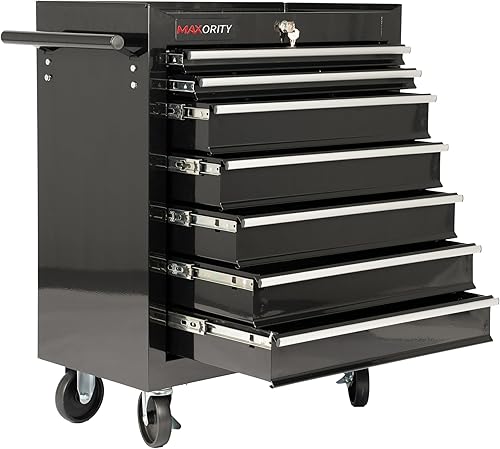 Best for drawer-focused storage
Maxority 7-Drawer Heavy-Duty Rolling Tool Chest
7.8/10 our score
See it on Amazon -
3

- 4
 Check it
LARBANKE 7-Drawer Rolling Tool Chest
Best for bench-side repairs - 5
 Check it
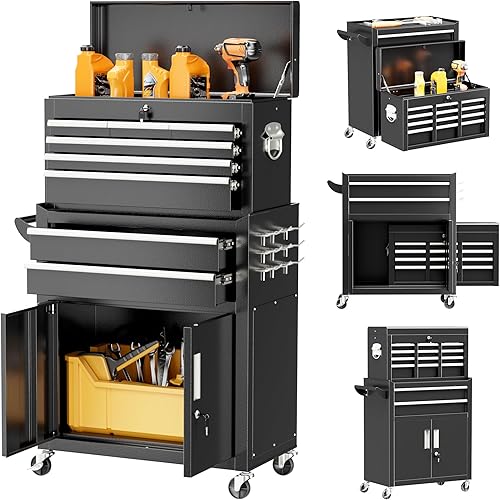
Superday 8-Drawer Rolling Tool Chest
Best for separate repair kits - 6
 Check it
SUXXAN 3-Drawer Rolling Tool Chest with Pegboard
Best for visible tool access
How we chose the best rolling tool chests
We favored useful storage layouts, movement controls and a sensible fit for home garages. SwellSatchel compared dimensions, drawer arrangements, detachable sections and wheel features to identify the buyer each chest suits.
Goplus leads because it combines flat storage for hand tools with space that can adapt to larger items. The other picks serve clearer needs, such as a lower drawer cart, more tool categories or visible hanging storage.
Drawer count did not settle the choice. A lower cupboard may serve a drill case better than several shallow drawers, while a drawer-only layout can make small hand tools easier to find.
These are compact cabinets, so confirm individual drawer and total load limits before buying for dense automotive tools. Steel construction, cabinet weight and the words “heavy duty” do not establish those limits.
Our tool chest size guide helps you plan the parked footprint and working clearance before narrowing the choices.
Compare these rolling tool chests
Choose the storage layout first, then use dimensions and wheel features to decide between close matches. Overall cabinet measurements describe the outside, so do not assume a long tool or fitted organizer will fit inside.
| Product | Best for | Drawer layout | Size | Mobility | Our score |
|---|---|---|---|---|---|
| Goplus 5-Drawer Rolling Tool Chest | mixed garage storage | 5 drawers and 2 trays | 23.5 in long x 11 in wide x 40 in high | 4 universal wheels, 2 with brakes | 8.7 |
| Maxority 7-Drawer Heavy-Duty Rolling Tool Chest | drawer-focused storage | 7 drawers | 24 in wide x 13 in deep x 30 in high | 4 lockable swivel wheels | 7.8 |
| Tuffiom 5-Drawer Rolling Tool Chest | bulky-tool storage | 5 drawers and 1 bottom cabinet | 23 in wide x 11 in deep x 40 in high | 4 wheels, 2 with brakes | 7.5 |
| LARBANKE 7-Drawer Rolling Tool Chest | bench-side repairs | 7 drawers in two heights | 24.6 in wide x 13 in deep; allow 28.7 in for height | 4 swivel wheels, 2 with brakes | 7.1 |
| Superday 8-Drawer Rolling Tool Chest | separate repair kits | 8 drawers and 1 bottom cabinet | 24.2 in wide x 13 in deep x about 42.5 in high | 4 wheels, 2 with brakes | 7.0 |
| SUXXAN 3-Drawer Rolling Tool Chest with Pegboard | visible tool access | 3 drawers and usable top | 18.11 in deep x 30.31 in wide x 35.5 in high | 4 casters and push handle | 6.8 |
A detachable top helps with nearby jobs, a lower cupboard suits bulky items, and an all-drawer cart suits tools stored in flat layers. Side storage works only when you can leave that side clear.
Which rolling tool chest suits your setup?
Choose Goplus for mixed home-garage storage, then consider another model only if its layout solves a more specific need. Each option below includes a reason to buy it and a reason to pass.
Goplus: best rolling tool chest for mixed storage
Goplus 5-Drawer Rolling Tool Chest
- 5 drawers and 2 trays
- Detachable top toolbox
- Four universal wheels, 2 with brakes
- 23.5 x 11 x 40 in
A detachable toolbox and adjustable lower storage suit a home garage with both hand tools and bulkier items. The top box can also be stored inside the lower chest.
Pros
- Separate upper toolbox
- Adjustable or removable bottom shelf
- EVA drawer padding and small-tool storage
Cons
- Wheels and racks need attaching
- A tall stacked layout may conflict with overhead shelves
Goplus suits a home garage where sockets, screwdrivers and small hand tools share space with larger equipment. Its adjustable or removable lower shelf gives you more layout options than a cabinet made entirely of shallow drawers.
The detachable upper toolbox is useful when a repair moves to another room or a nearby workbench. Keep a basic repair kit in that section so you can carry what you need without sorting through the whole cabinet.
Movable door hooks and six holes in the side handle provide places for small tools. Keep those items within the cabinet's clear travel path so they do not catch on shelves or brush against a vehicle.
You can nest the top toolbox in the lower chest when you need to reduce the stacked height. That uses the same space you might otherwise reserve for bulkier tools, so plan which purpose matters more.
Buy it for varied storage needs and occasional use of a separate toolbox. Skip it if nearly all your tools need flat drawer space or you want a low cart to park beneath a bench.
The main unit arrives pre-assembled, with wheels and racks still to attach. Complete those steps before loading tools so you can reach the mounting points without moving a filled cabinet.
Maxority: for tools sorted into flat layers
Maxority 7-Drawer Heavy-Duty Rolling Tool Chest
- 7 drawers
- Ball-bearing slides
- 4 lockable swivel wheels
- 24 x 13 x 30 in
Seven drawers with ball-bearing slides suit tools you want sorted into separate layers. Its lower cabinet height is useful where a stacked chest would crowd overhead storage.
Pros
- Seven separate tool groups
- Ball-bearing drawer slides
- All four swivel wheels lock
Cons
- Assembly is required
- No detachable toolbox or lower cupboard in this layout
Maxority suits a collection that divides neatly into drawer groups, such as sockets, wrenches, pliers and measuring tools. Its ball-bearing slides are a reason to consider it if you expect to open drawers often during a job.
The lower cabinet height makes it worth considering beneath wall shelves or beside a bench. Measure any under-bench opening with room for the top and handle, rather than assuming a cabinet will slide straight under.
All four swivel wheels are lockable, which gives you parking controls at each corner. Check that you can reach them in the intended storage spot, especially if the cabinet sits close to a wall.
At 60 lb before tools, it needs a planned route from delivery to assembly. Arrange help for lifting and avoid treating the wheels as a way to negotiate stairs.
Buy it for a drawer-based collection that stays in the garage. Skip it if you need an enclosed cupboard for bulky cases or want to carry a detachable toolbox away from the base.
Before loading, assign a job to each drawer. This helps you judge whether you need seven useful storage layers or simply more room for a few large items.
Tuffiom: for hand tools and bulkier equipment
Tuffiom 5-Drawer Rolling Tool Chest
- 5 drawers and bottom cabinet
- Detachable top toolbox
- Adjustable, removable shelf
- 23 x 11 x 40 in
An adjustable lower shelf gives you a place for items that do not suit shallow drawers. Side handles help you carry the detachable upper chest to a nearby job.
Pros
- Enclosed lower storage with an adjustable shelf
- Detachable top with side handles
- Locking bars restrain drawers and cabinet door
Cons
- Remove the shelf before nesting the top chest
- Storing the top inside uses the lower cabinet space
Tuffiom suits buyers who want hand tools in drawers and larger items behind a cabinet door. Its adjustable lower shelf lets you change that split as your collection grows.
Start by measuring the bulkiest item you plan to store below. A removable shelf creates a taller opening, but the cabinet's interior width, depth and door opening still control what fits.
The detachable top has handles on both sides, giving you grips for carrying it to a nearby job. Keep its contents modest enough to lift comfortably, since a portable section can become awkward once filled with metal tools.
The upper chest can fit inside the bottom cabinet after you remove the shelf. Use that arrangement for storage or transport planning, rather than expecting to keep the lower compartment fully loaded at the same time.
Buy it when enclosed lower storage is essential and a separate upper box would be useful. Skip it if you want every tool visible in a flat drawer or do not want to rearrange contents before nesting the sections.
Compared with Goplus, the main decision is how you would use the lower space and upper toolbox. Sketch both arrangements around your own tools instead of choosing by a small difference in exterior size.
LARBANKE: for tools beside an active repair
LARBANKE 7-Drawer Rolling Tool Chest
- 7 drawers with two drawer heights
- Drawers pull out completely
- Compartmented plastic top
- Four swivel wheels, 2 with brakes
Full-extension drawers help you reach tools at the back, while top compartments keep current-job items apart. Connecting rods support expansion with compatible same-series chests.
Pros
- Full-extension access
- PE foam drawer padding
- Compartmented top for current-job tools
Cons
- Plastic top needs protection from hot tools and heavy impacts
- Shallow drawer heights limit taller tools and organizers
LARBANKE suits a bench-side setup where you want current-job tools on top and stored tools within easy reach. Full-extension drawers help you reach the back without moving everything at the front.
Its two drawer heights, 1.37 in and 3.1 in, make tool thickness a key fit check. Measure tools in their holders, because a socket rail or fitted tray takes more height than loose pieces.
The compartmented plastic top can separate the tools and small items needed for the current task. Use a proper bench for hammering, clamping and hot work, and protect the top from sharp or heated items.
PE foam padding cushions drawer contents, but holders and dividers still help keep small pieces in place. Leave enough clearance for drawers to close freely after adding organizers.
Connecting rods allow expansion with compatible LARBANKE chests in the same series. Plan the combined footprint and follow the connection instructions before building a larger arrangement.
Buy it for easy rear-drawer access and a place to sort current-job items. Skip it if tall cases dominate your collection or you need the cabinet top to serve as a general workbench.
Superday: for several separate repair kits
Superday 8-Drawer Rolling Tool Chest
- 8 sliding drawers
- Detachable toolbox and rolling chest
- Four wheels, 2 with brakes
- 24.2 in wide x 13 in deep x about 42.5 in high
Eight drawers suit a collection divided into several repair kits or tool families. A detachable upper toolbox lets you carry a selected set away from the rolling base.
Pros
- Most drawers in this group
- Mixed drawer sizes and a lower cabinet
- Two locking levers restrain storage during movement
Cons
- Tallest cabinet in this group
- Wheels and brackets still need attaching
Superday suits a collection split into several distinct groups, such as bicycle tools, household repair supplies and automotive hand tools. Its eight drawers offer more separate categories than the other picks here.
The drawer mix includes two large, three medium and three small drawers. Assign the small drawers to compact items rather than scattering the same type of fastener or accessory across several places.
A detachable top lets you keep one useful kit ready to carry. Reserve it for the tools needed away from the cabinet, while storing dense or rarely moved items lower down.
This is the tallest option in the group, so check overhead shelves and your reach to the upper storage. Avoid placing heavy tools high simply because an upper drawer has empty space.
The main unit is pre-assembled, with wheels and brackets still to fit. Before loading, learn how its two locking levers secure the drawers, trays and lower cabinet for movement.
Buy it when separate tool categories matter most and you have room for a tall stack. Skip it if most of your collection consists of bulky cases or if a lower cart would be easier to reach.
SUXXAN: for visible tools beside the work area
SUXXAN 3-Drawer Rolling Tool Chest with Pegboard
- 3 drawers and usable top
- Side pegboard for compatible hooks
- 4 casters and push handle
- 18.11 x 30.31 x 35.5 in
A side pegboard keeps frequently used small tools visible, leaving three drawers for other supplies. Plan space beside the cabinet so hanging tools remain easy to reach.
Pros
- Side pegboard for compatible hooks
- Push handle for repositioning
- Usable top beside the work area
Cons
- Fewer drawers for separate tool groups
- Wider and deeper than the other picks
- Assembly is required; plan for compatible hooks separately
SUXXAN suits a workspace where a few frequently used tools should stay visible on the side of the cabinet. Its pegboard gives compatible hooks a place beside three drawers and a usable top.
That arrangement works well only if you can reach the side panel. Parking it tightly between a bench and a wall would waste the feature that makes this cabinet different.
Plan compatible hooks separately, and leave space for both the hooks and hanging tools. Keep sharp ends protected and avoid hanging items where they could catch as you move the cabinet.
The cabinet is wider and deeper than the other picks, so allow for turning as well as parking. A push handle provides a grip for repositioning it on a suitable level indoor floor.
Assembly requires aligning the frame and drawers before final tightening. Follow the instruction order so a twisted frame does not leave drawers rubbing or sitting unevenly.
Buy it for visible access to a small working set rather than many separate drawer categories. Skip it if you need a narrow storage slot or prefer all tools enclosed.
For tools that need to travel farther than the next work area, compare the portable systems in our best rolling tool boxes guide.
What size rolling tool chest fits your garage?
A chest fits only when you have room to park it, open it and move it. Measure those three spaces separately before choosing a cabinet.
Mark the outside footprint on the floor with removable tape or cardboard. Include any handles and side storage, then stand where you would normally reach into an open drawer.
Check the narrowest point on the delivery route, including door frames and turns beside shelving. A straight doorway measurement will not tell you whether a wide cabinet can turn into a crowded corner.
For drawer clearance, leave room for the drawer to extend and for you to stand or bend comfortably in front. Check this with the car parked in its usual spot.
Height matters beneath shelves, but reach matters too. You should be able to see and retrieve upper tools without leaning over an unstable pile or lifting a heavy item from an awkward position.
The exterior footprint is not usable drawer space. Measure your longest wrench, largest case and tallest organizer, then confirm the interior dimensions needed for each.
If you need help planning the room around the chest, read how to choose a tool chest for your garage.
Which drawer layout fits your actual tools?
Choose drawers for flat tools and cabinet space for bulky items. Count the tool groups you need to separate before deciding how many drawers to buy.
Plan drawers around tool thickness
Lay out one proposed drawer group on a bench or sheet of cardboard. Allow space to grip tools, read size marks and remove a piece without lifting several others.
Measure the tallest item in its intended holder. Deep sockets stored upright, pliers with thick handles and stacked cases can require more clearance than their appearance suggests.
Leave some spare space in the busiest drawer. A tightly packed arrangement becomes harder to maintain as soon as you add a new tool.
Use lower storage for awkward shapes
A cupboard is useful for cases and items that do not lie flat. Check the door opening as well as the space inside, especially for a case that must enter at an angle.
An adjustable shelf can separate smaller items or make room for something taller. Avoid stacking several cases so that reaching the bottom one requires unloading the cabinet.
Should you choose a detachable top toolbox?
Choose a detachable top if you regularly carry a small repair kit away from the rolling base. Goplus, Tuffiom and Superday offer that option.
A useful portable kit contains the tools for a repeat task, rather than a random share of the whole collection. Keep the tools you usually need together in that section.
Think about lifting before filling it. A box that is easy to carry empty can become awkward once loaded with sockets, wrenches and other dense tools.
Nesting an upper box inside a lower cabinet saves stacked height but takes away lower storage. If that would force you to empty the cabinet each time, the feature may have little value in daily use.
Choose a drawer cart instead if nearly every job happens beside the same bench. You can still carry a small tray of selected tools without rearranging a stacked chest.
How should you set up and load a rolling tool chest?
Assemble and inspect the empty chest before loading tools, then place the heaviest items low. That makes it easier to correct alignment, attach hardware and check movement.
- Inspect the parts. Check for bent panels, damaged casters, missing hardware and drawers that rub.
- Follow the assembly order. Fit the wheels, handle, racks and other required parts as directed, using help when turning or lifting the cabinet.
- Check movement while empty. Open and close each drawer, operate restraints and check any wheel brakes.
- Plan the load. Keep dense tools in lower storage, frequent-use tools within easy reach and light items higher up.
- Add weight gradually. Confirm the relevant load limits and stop if drawers bind, wheels strain or the cabinet becomes difficult to control.
Open one drawer at a time and close it before opening another. Do not use a drawer as a step, seat or support for a heavy object.
Keep the top clear enough to put down a tool safely. Unless a top is intended for the task, use a separate workbench for impact work, clamping or heavy repairs.
How do you move a loaded chest safely?
Move a loaded chest slowly on a clear, level route, with drawers and doors closed and secured. Remove loose items from the top before releasing wheel brakes.
Check for cords, loose screws, floor joints and debris along the route. A small obstruction can stop a caster abruptly while the rest of the cabinet is still moving.
Use the intended handle and keep the cabinet upright. Do not pull it by an open drawer, a removable rack or a hanging tool.
For stairs, curbs or difficult thresholds, unload and arrange suitable help or equipment. A rolling cabinet is designed for floor movement, and its casters do not make every route suitable.
Wheel brakes and drawer restraints serve different jobs: brakes hold the parked cabinet, while restraints keep storage closed during movement. Our guide to tool chests on casters explains the wheel features worth checking.
How can you organize and care for a rolling tool chest?
Give each tool a clear home, then keep drawers and wheels free of grit. A simple arrangement is easier to maintain than a packed drawer with tools layered out of sight.
Group by task when tools usually travel together, or by type when you choose individual pieces throughout a job. Put loose fasteners in closed containers so one spilled tray does not fill the drawer slide area.
Use dividers where small tools drift into neighboring groups. Our tool chest drawer divider guide explains how to fit sections without blocking access.
Wipe tools dry before putting them away, and clean spills promptly. Powder coating does not remove the need to protect exposed scratches and keep moisture out of stored tools.
Lift removable liners occasionally to clear trapped grit and check for damp areas. Clean slides and lubricate moving parts only as the manufacturer's instructions allow.
Remove hair, thread and debris from caster wheels, then check that mounting hardware stays secure. For a fuller storage plan, follow our guide to organizing a tool chest.
Which buying mistakes are easiest to avoid?
Avoid choosing by drawer count, exterior size or a heavy-duty label alone. Those details do not establish tool fit, load capacity or ease of use.
- Buying organizers first: measure usable drawer space before ordering trays, rails or foam.
- Ignoring side clearance: hooks and racks need room beyond the cabinet body.
- Filling every gap: leave enough space to grip tools and return them easily.
- Loading the top heavily: store dense tools low and keep current-job items on top.
- Expecting a carry box to stay light: plan its contents around comfortable lifting.
- Treating locks as complete security: secure the garage and valuable tools appropriately for your needs.
Also avoid buying storage for an imagined collection. Solve the problems your current tools create, then leave modest room for growth.
Which best rolling tool chest should you buy?
Choose Goplus for varied home-garage storage, especially if a separate toolbox would earn regular use. Pick Maxority when your collection suits flat drawer groups, or Tuffiom when bulkier equipment needs an adjustable lower cupboard.
Choose LARBANKE for access to the back of drawers beside a repair area, Superday for several separate tool kits, or SUXXAN for visible side-hung tools. Pass on any layout that cannot hold your largest tools comfortably.
The best rolling tool chest is the one you can load sensibly, reach easily and move along your real garage route. Before ordering, use our tool chest size guide to confirm both the parked space and open-drawer clearance.
Our top 3 picks at a glance
-
1
-
2
Best for drawer-focused storage
Maxority 7-Drawer Heavy-Duty Rolling Tool Chest
7.8/10 our score
See it on Amazon -
3
Frequently asked questions
What should I look for in a rolling tool chest?
Match the chest to your largest tools, available floor space and usual work area. Check usable drawer dimensions, lower cabinet space, wheel brakes and restraints that keep drawers closed during movement.
Measure the delivery route and open-drawer clearance too, and confirm load limits before storing a dense collection of metal tools.
Are more drawers always better?
No. More drawers help when you have several tool groups to separate, but shallow drawers may waste space if your collection includes bulky cases or tall equipment.
Sketch a storage plan first, then choose the drawer and cabinet mix that fits it.
Leave room for organizers and a few future tools.
Do rolling tool chests need wheel brakes?
Wheel brakes are useful for keeping a chest parked while you reach for tools. They work alongside a level floor and sensible loading, rather than replacing either.
Check how the brakes operate, engage them before opening drawers, and close and secure all storage before moving the chest to another work area.
How do I keep tools from shifting in a rolling chest?
Use fitted liners and dividers to limit sliding, then give loose sockets, bits and fasteners their own holders or containers. Keep heavy tools low and secure drawers before rolling.
Our tool chest drawer liner guide explains how to choose and fit liners without crowding the drawer.