5 Best Small Rolling Tool Chests (October 2026)
The best small rolling tool chests include the Keter Stack-N-Roll 3-Piece Rolling Tool Box for compact home workshops, the Milwaukee Packout 22-Inch Rolling Tool Box for existing Packout users, and the Craftsman VERSASTACK 17-Inch Rolling Tool Box for separate project kits.
On this page (8 sections)
- Which small rolling tool chest is best for your setup?
- What should you measure before buying a small rolling tool chest?
- Do you need drawers, stacked boxes or an expanding workstation?
- How much weight should a compact rolling tool chest carry?
- How should you set up a compact rolling tool chest?
- What care keeps rolling tool storage easy to use?
- Which buying mistakes cause trouble in a small workspace?
- Verdict: which small rolling tool chest should you choose?
The Keter Stack-N-Roll 3-Piece Rolling Tool Box is the best small rolling tool chest for home projects that need separate places for tools and hardware. Choose Milwaukee if you already use Packout, or FLEX if quick drawer access matters and you have a compatible rolling base.
The key choice is how you reach your tools. A stack of boxes packs different tool groups together, drawers keep frequently used tools accessible, and an expanding workstation opens several storage levels beside your project.
For a broader look at these layouts, see our complete guide to rolling tool chests and boxes. Use tool chest sizes for a home garage if you're still deciding how much storage your space can hold.
Our picks at a glance
-
1
 Best for compact home workshops
Keter Stack-N-Roll 3-Piece Rolling Tool Box
9.1/10 our score
See it on Amazon -
2
 Best for existing Packout users
Milwaukee Packout 22-Inch Rolling Tool Box
9.0/10 our score
See it on Amazon -
3
 Best for separate project kits
Craftsman VERSASTACK 17-Inch Rolling Tool Box
8.0/10 our score
See it on Amazon
- 4
 Check it
FLEX Stack Pack 3-Drawer Tool Box
Best for frequent small-tool access - 5
 Check it
Craftsman 22-Inch Rolling Tool Box
Best for projects beside the cart
Which small rolling tool chest is best for your setup?
Choose Keter for a complete home-project set, Milwaukee for Packout compatibility, or VERSASTACK for removable project boxes. FLEX serves buyers who need drawers, while the Craftsman workstation suits jobs where the cart stays open beside the work.
These picks favor portable storage rather than traditional steel drawer cabinets. FLEX is the exception within this group: it's a drawer module that needs a separate rolling base.
We compared storage layout, dimensions, load guidance and mobility features. The main buying question is whether each design makes your tools easier to reach in the space where you'll use them.
| Product | Best for | Size (L x W x H) | Capacity | Material | Our score |
|---|---|---|---|---|---|
| Keter Stack-N-Roll 3-Piece Rolling Tool Box | compact home workshops | 16.18 x 20.66 x 27.32 in | 165 lb | Resin | 9.1 |
| Milwaukee Packout 22-Inch Rolling Tool Box | existing Packout users | 22.1 x 18.9 x 25.6 in | Impact-resistant polymers | 9.0 | |
| Craftsman VERSASTACK 17-Inch Rolling Tool Box | separate project kits | 19.89 x 16.97 x 30.81 in | Plastic | 8.0 | |
| FLEX Stack Pack 3-Drawer Tool Box | frequent small-tool access | 22 x 15.1 x 16.3 in | 70 lb | 7.0 | |
| Craftsman 22-Inch Rolling Tool Box | projects beside the cart | 21.5 x 16.2 x 28.8 in | 6.9 |
Keter Stack-N-Roll 3-Piece Rolling Tool Box
- Cart, toolbox and parts organizer
- Metal telescoping handle
- 7 in wheels and side grips
- Transparent polycarbonate organizer lid
A connected set for home projects that need bulky tools, hand tools and small parts in separate places. Detachable pieces let you take the relevant box to the task.
Pros
- Three storage pieces included
- Interlocking modules
- Clear lid keeps small parts visible
Cons
- Lower storage takes more steps to reach when stacked
- Separated modules need a place to sit
Keter is the strongest starting point for a home tool collection that includes power tools, hand tools and loose hardware. Its cart, toolbox and parts organizer give those groups separate homes without making you choose extra modules first.
The assembled set measures 16.18 x 20.66 x 27.32 in and has a stated 165 lb capacity. Its resin construction, metal telescoping handle, 7 in wheels and side grips support moving the set between storage and a project.
The transparent polycarbonate organizer lid helps you spot small parts before opening it. Audible closure latches give a useful cue when packing up, though you should still check that each closure and module connection is fully engaged.
Buy it if you want to roll a mixed kit to the work area, then separate the pieces around the task. It also suits buyers who want hardware stored apart from larger tools without filling a deep box with loose containers.
Skip it if you need frequent access to tools in the lower storage while the system stays stacked. For that routine, drawers save repeated lifting and rearranging.
Put your most-used repair supplies in the easiest piece to remove. Our guide to how to organize a tool chest can help you group tools by task rather than packing them wherever they fit.
Milwaukee Packout 22-Inch Rolling Tool Box
- Compatible with Packout modular storage
- Industrial grade extension handle
- 9 in wheels
- IP65 weather seal
A rolling base box for buyers building around Packout modules. Its single main compartment favors larger tools, with separate organization needed for loose hardware.
Pros
- Connects with Packout modular products
- Metal-reinforced corners and locking point
- Weather seal for dust and water protection
Cons
- Interior organizer tray is not included
- Empty weight matters when lifting into a vehicle
Milwaukee is the logical choice when Packout compatibility determines the rest of your storage plan. It lets you build around a rolling box rather than replace compatible modules you already use.
The box measures 22.1 x 18.9 x 25.6 in and weighs 23.4 lb empty. That weight matters if your route ends with lifting the box into a vehicle instead of rolling it all the way.
Its industrial grade extension handle, 9 in wheels, metal-reinforced corners and reinforced locking point suit a transport-focused setup. An IP65 weather seal adds protection from dust and water, but tools should still be packed dry before storage.
The single main compartment works best when larger tools need room together. An interior organizer tray isn't included, so plan separate containers if sockets, bits or fasteners would otherwise settle beneath those tools.
Choose it if you want a Packout base or commonly transport bulky equipment. Skip it if your main need is a ready-made collection of small compartments, or if lifting the empty box already feels close to your comfortable limit.
Check the full stack before choosing a parking spot, since added modules change the storage height and access routine. Our Milwaukee Packout dimensions guide covers the broader system sizes.
Craftsman VERSASTACK 17-Inch Rolling Tool Box
- Mobile base, deep toolbox and organizer
- Side latches connect the units
- Push-button telescopic handle
- IP54 dust and water resistance
A tower for buyers who want to separate tools and supplies into removable project boxes. Check overhead clearance and resolve the differing load figures before packing it.
Pros
- Three stackable units included
- Modules can be separated for individual tasks
- Rust-resistant metal closure latches
Cons
- Tallest assembled option here
- Different load figures need clarification before use
VERSASTACK suits buyers who want separate project kits in one rolling tower. The mobile base, middle deep toolbox and top organizer can keep larger equipment apart from repair tools and hardware.
The assembled tower measures 19.89 x 16.97 x 30.81 in, making it the tallest complete setup here. Check shelf clearance as well as the space needed to lift off an upper box.
Side latches connect the modules, and all 3 units have IP54 dust and water resistance. The metal-plastic telescopic handle opens with a push button and leans backward to leave room for storage.
The load guidance needs clarification: Craftsman gives figures of 65 lb maximum weight, 66 lb for the rolling unit and 110 lb when stacked. Confirm which limit applies to your arrangement before loading; don't use the largest figure as a general transport allowance.
Buy it if you regularly detach a box for a particular job while leaving other supplies behind. Skip it if your storage spot has low overhead clearance or your intended load depends on resolving those different capacity figures.
If you mainly roll tools around one garage, a drawer cabinet may fit your routine better. Read what to know about a tool chest on casters to compare that movement pattern with a pull-behind tower.
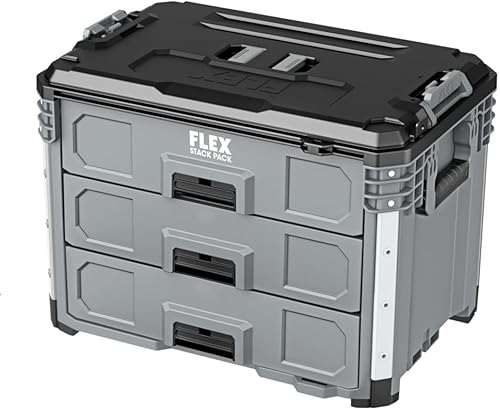
FLEX Stack Pack 3-Drawer Tool Box
- Three drawers with removable dividers
- Auto-locking drawer mechanisms
- Onboard security bar
- STACK PACK attachment compatibility
Drawer storage for buyers who repeatedly reach for compact tools and hardware. This is a drawer module, so a compatible rolling base must be planned separately.
Pros
- Includes 6 long and 18 short dividers
- Drawers stay closed during transport
- Rust-resistant drawer rails
Cons
- Rolling base is not included
- Weighs 29.5 lb before tools are added
FLEX is the choice for buyers who spend more time retrieving small tools than moving large boxes. Its drawers let you keep tool groups accessible without removing the storage above them.
The module measures 22 x 15.1 x 16.3 in, weighs 29.5 lb empty and has a 70 lb load capacity. It doesn't include a rolling base, so account for the complete setup rather than comparing its height alone with the rolling sets.
Each of the 3 drawers has removable dividers, with 6 long and 18 short dividers included. Use them to create spaces for tool groups and hardware while leaving longer items enough room to lie flat.
Auto-locking mechanisms keep drawers closed during transport, and an onboard security bar provides a separate way to secure them. Rust-resistant rails support drawer movement, while quick-connect latches link the box with the STACK PACK system.
Buy FLEX if you already have a compatible rolling arrangement or are deliberately building a drawer-based setup. Skip it if you need wheels included or mostly store bulky tools that belong in a deep compartment.
Plan the drawer layout around the tools you reach for together. Our drawer divider setup guide explains how to size compartments without wasting usable space.
Craftsman 22-Inch Rolling Tool Box
- Four storage compartments
- Expanding workstation layout
- Ball-bearing slides
- Lowering telescopic handle
An expanding workstation for buyers who want several storage levels visible beside a project. Allow enough working space for the unit to open fully.
Pros
- Four levels separate tools and accessories
- Single front pull-up opening latch
- Reinforced metal telescopic handle
Cons
- Open workstation needs more space than the closed unit
- Not a substitute for removable project boxes
The Craftsman 22-Inch Rolling Tool Box suits projects where you want several storage levels open beside you. Its expanding workstation format puts different tool groups within view instead of requiring a separate surface for each box.
The closed unit measures 21.5 x 16.2 x 28.8 in, with an 88 lb maximum weight recommendation. Those dimensions describe its parked size, so leave additional room for the workstation to extend.
A single front pull-up latch opens the unit, and ball-bearing slides guide its movement. The reinforced metal telescopic handle lowers for storage, while the wheels let you move the closed workstation between work areas.
Choose it if you usually settle beside one task and want larger tools, hand tools and accessories in separate levels. This layout makes more sense beside an open repair area than in a narrow passage.
Skip it if you need to keep storage accessible while the unit remains tucked beneath a bench. Also choose a detachable system instead if you often carry individual project boxes away from the cart.
Keep frequently used items where you can reach them without leaning across the open unit. For storage that stays in a fixed workshop position, compare tool cabinets for the garage before committing to an expanding design.
What should you measure before buying a small rolling tool chest?
Measure parking space, working space and the travel route as 3 separate checks. A chest can fit neatly beside a bench yet become awkward as soon as you open it or pull it toward a doorway.
Measure your small rolling tool chest in use
Mark the closed footprint on the floor with removable tape. Then mark where you'll stand and where the lid, drawers, handle or expanding sections need room to move.
For stackable boxes, include a nearby landing spot for removed modules. If the only place to put an upper box blocks the doorway, the storage arrangement needs changing before you buy.
Check overhead space beneath shelves or benches. A box that slides underneath when closed may still need to be pulled completely out before you can open its lid.
Check turns, thresholds and vehicle loading
Measure the narrowest part of your route, including door trim and the space around parked equipment. Remember that turning a rectangular box takes more room than pulling it along a straight path.
Identify every point where rolling becomes carrying, such as steps, a raised doorway or a vehicle cargo opening. Buy for the hardest part of that route, since wheels don't remove the need to lift.
For more help matching storage to a crowded workspace, see our guide to choosing a tool chest for your garage.
Do you need drawers, stacked boxes or an expanding workstation?
Choose drawers for repeated access, detachable boxes for project kits, and an expanding workstation for tools you want visible beside a job. Start with your work pattern rather than the number of compartments.
Drawers make sense when you switch often among sockets, pliers, drivers and small supplies. You can return each tool to its place without reopening a deep box or moving another module.
Stackable boxes make sense when you pack by task. A plumbing kit, an assembly kit and a power-tool kit can stay separate, letting you take only what the next job needs.
The drawback is access to lower storage. If you reach for the bottom box throughout the day, put those tools higher or choose drawers for that part of the collection.
An expanding workstation suits a project with enough clear floor space to remain open. It becomes less convenient if someone needs to pass through the area or you must close everything whenever you move.
If you expect to add modules later, compare connection systems before choosing a base. Our guide to choosing a modular rolling tool box system explains how to plan around access and future storage needs.
How much weight should a compact rolling tool chest carry?
Choose a setup that holds your actual tool load within every applicable limit. Storage volume and load capacity answer different questions: a box can have empty space left after its safe weight allowance is reached.
Weigh your tools in manageable groups, then include batteries, organizers and the hardware you normally carry. Dense items such as sockets and fasteners can add substantial weight without filling a compartment.
Separate the contents allowance from the total weight you'll lift. The empty chest, rolling base and extra modules all contribute when you load the whole arrangement into a vehicle.
Keep heavy items low and spread the load across the base. Avoid concentrating dense hardware in one upper corner, especially on a tall stack.
A whole-system limit doesn't automatically apply to each drawer, lid or handle. Follow the instructions for the exact arrangement, and resolve conflicting figures before you load it.
For planning a move or vehicle lift, read how heavy a tool chest gets when loaded. If you can't comfortably handle the packed setup, split the tools into smaller loads rather than filling to the maximum.
How should you set up a compact rolling tool chest?
Start with an empty chest and a tool layout, then load it in stages. This gives you a chance to spot poor access or a blocked closure before the storage becomes heavy.
- Check the empty unit. Operate the handle, closures, module connections and any drawers or slides according to the instructions.
- Group tools by task. Keep items used together in the same compartment instead of sorting only by shape.
- Place dense items low. Reserve easier-to-reach areas for the tools you repeatedly pick up.
- Fit organizers around the tools. Leave room for handles, battery packs and anything that stands above a divider.
- Check the loaded arrangement. Close each compartment fully, confirm the connections and move slowly over a clear route.
Leave a little spare space in each project kit. A box packed tightly to its edges becomes harder to close when you add the fasteners, tape or accessories needed for the next repair.
For drawers, a properly fitted liner can reduce tool movement, but it also uses some clearance. See tool chest drawer liners and fitting tips before cutting material or filling shallow drawers.
Label removable boxes by task or contents. Clear labels are especially useful when several closed modules look alike and you need one without opening the full stack.
After a few projects, move rarely used items out of prime access positions. Let the layout reflect what you reach for rather than preserving the first arrangement.
What care keeps rolling tool storage easy to use?
Keep wheels, closures and sliding parts free of debris, and store tools dry. Small pieces of grit can interfere with moving parts, while trapped moisture can affect the tools inside even when the container resists water.
Brush dirt from wheel hubs and wipe the wheels before bringing the chest onto a clean indoor floor. Inspect for trapped wire, string or other material if a wheel starts dragging.
Wipe sealing surfaces before closing a box after dusty work. Water resistance is useful protection during transport, but it isn't a reason to leave wet tools sealed away.
Don't force a drawer or lid that won't close. Remove the obstruction and rearrange the contents, since pressure from an overfilled compartment can prevent the closure from engaging.
Follow the manufacturer's care instructions for rails, handles and connections. Add lubricant only where recommended, since the wrong treatment can attract dirt or affect materials.
Before transport, close drawers and lids, secure the module connections and stow loose accessories. Use the carrying points specified for the unit rather than assuming an extended pulling handle is a lifting handle.
Which buying mistakes cause trouble in a small workspace?
The biggest mistake is buying for the closed footprint alone. Opening space and tool access determine whether the chest works once it's in your garage.
Another mistake is choosing capacity before sorting the tools. A large deep compartment won't organize loose bits by itself, while shallow drawers may leave your largest tool without a home.
Avoid treating every modular system as interchangeable. Choose boxes, bases and attachments that are explicitly compatible rather than relying on similar dimensions or latch shapes.
Don't assume wheels make a tall load easy to move everywhere. Slow down at thresholds, keep the route clear and separate modules when the instructions or conditions call for carrying them individually.
Security also needs a separate plan. A locking point or security bar can restrict access, but it doesn't anchor the whole chest in place.
Finally, don't buy a drawer module as though it's a complete rolling chest. Include the compatible base, connection method and total assembled size in your decision before comparing it with an all-in-one set.
Verdict: which small rolling tool chest should you choose?
Choose your small rolling tool chest by the access pattern you'll use most. The right layout should let you reach the next tool without moving half your storage.
Pick Keter for a home-project collection that needs a cart, toolbox and organizer together. Pick Milwaukee when existing Packout modules or a bulky-tool transport routine make its rolling base box the better fit.
Choose VERSASTACK for detachable project kits after checking clearance and load guidance. Choose FLEX for frequent drawer access with a compatible rolling base, or the Craftsman workstation when you can leave several storage levels open beside the job.
Before ordering, mark the parking spot and opening area, then map the route with a loaded kit in mind. If you need a traditional drawer cabinet instead, continue with our best rolling tool chests roundup.
Our top 3 picks at a glance
-
1
Best for compact home workshops
Keter Stack-N-Roll 3-Piece Rolling Tool Box
9.1/10 our score
See it on Amazon -
2
Best for existing Packout users
Milwaukee Packout 22-Inch Rolling Tool Box
9.0/10 our score
See it on Amazon -
3
Best for separate project kits
Craftsman VERSASTACK 17-Inch Rolling Tool Box
8.0/10 our score
See it on Amazon
Frequently asked questions
What size rolling tool chest is considered small?
A small rolling tool chest fits both your parking space and the area needed to use it. There isn't one size cutoff that works for every garage.
Measure the closed footprint, opening space and route to your projects, including doorways, tight turns and clearance beneath shelves.
Is a rolling tool chest better than a stackable tool box?
Choose drawers for frequent tool access and stackable boxes for separating project kits. A stackable system with a wheeled base combines removable boxes with rolling transport.
The deciding factor is how you work: repeatedly reaching for tools favors drawers, while carrying one project kit favors detachable modules.
How much weight can a small rolling tool chest hold?
The safe load depends on the exact model, module and transport arrangement. A system's total capacity doesn't give every drawer or box the same allowance.
Follow the instructions for each component, count organizers as part of the load and check separate transport limits before moving a loaded stack.
Can I use drawer dividers in a small rolling tool chest?
Yes, provided the dividers fit the usable drawer space and leave enough height for tools and drawer closure. FLEX includes removable dividers for its drawers.
For other storage, measure inside the compartment before buying inserts, and check that sockets, handles and taller accessories don't catch as the drawer closes.